Compare a fully costed helper trial with solo work and identify the worker, coverage, training, access, and quality checks required before adding help.
Open the full-size diagram ↗
Example and worksheet
Use the separately labeled Case H teaching records, then create a dated record for your own assessed service. Fictional results do not establish practical readiness or local demand.
- Case H 06 · Read the management result on a consistent basis
- Case H 07 · Budget the entire owner cycle
- Case H 09 · Plan the repeat as a separate agreement
- Case H 12 · Preserve the accepted plan and transfer the method
Download the formula planner ↓
Example tab: First plan. Your blank tab: Your estimate.
Open the downloaded workbook and select the named tab. Use the example for reasoning, then enter your own supported inputs in a separate blank Your sheet.
Add help to a defined bottleneck
A helper can add capacity, but another person also adds coordination, pay obligations, supervision, equipment needs, and access responsibility. Identify the problem first: a task that can be assigned safely, a schedule that cannot fit the owner cycle, or an actual backlog of suitable work. Do not hire against hoped-for bookings or assume that a second worker automatically doubles completed visits. H03 should show the current owner constraint and H22 should compare a specific alternative on the same scope.
Separate elapsed customer time from person-hours. Two people may work in parallel on suitable tasks, yet travel, loading, inspection, training, and recordkeeping do not all disappear. Some areas cannot be worked simultaneously without crossing paths or introducing contamination risks. A household also needs to know who will be entering. Plan the route, separation of supplies, assigned tasks, and handoff before relying on a shorter onsite block. A faster clock time can still consume more total labor and produce a smaller result.
Research the relationship before choosing a label
Use current official guidance to determine worker classification and the obligations that follow. For federal tax purposes, the IRS considers the facts of control and the relationship; calling someone an independent contractor does not settle those facts. Washington workers' compensation requirements are a separate assessment. L&I cautions that a 1099 or business registration by itself does not establish an exemption from coverage. Other employment rules may also apply. Record the agencies, questions, and qualified advice needed for the actual arrangement.
Budget lawful pay, employer taxes, applicable coverage, paid time, training, recordkeeping, and any other required costs using verified local inputs. Do not use the fictional hourly assumption below as a wage benchmark or a complete payroll quote. Confirm the insurance implications of a helper entering occupied homes and handling property. A cheap hourly number can hide obligations larger than the visible pay. If classification or coverage remains unresolved, keep the trial on hold rather than testing the arrangement informally on a customer's premises.
Work the separate post-training first-visit trial
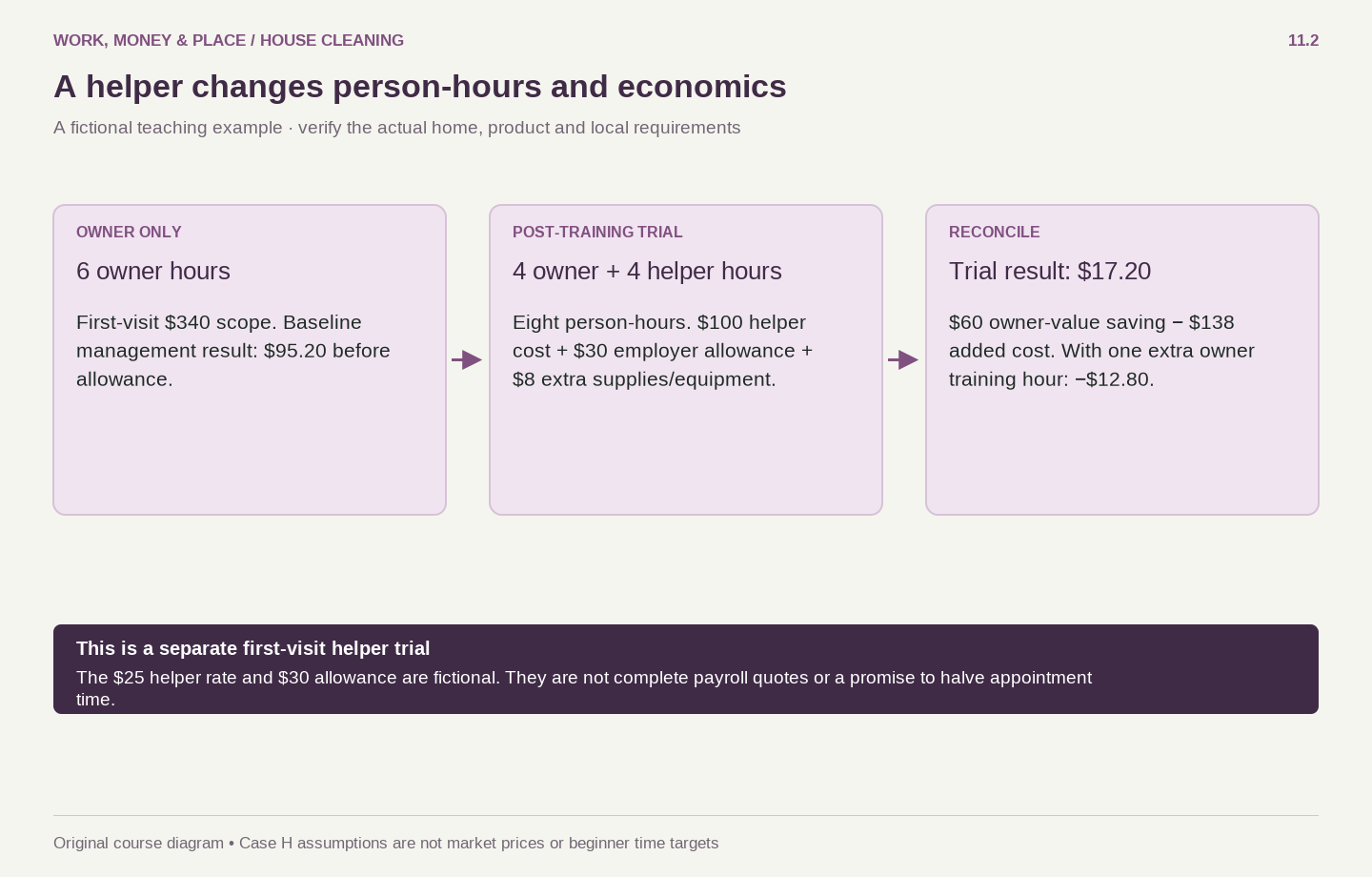
This teaching comparison is a POST-TRAINING HELPER TRIAL ON THE FIRST-VISIT $340 SCOPE. It is not Case H's $280 repeat, not an actual payroll arrangement, and not a recurring-result forecast. The solo first plan uses six owner hours and yields $95.20 before allowance and other business taxes. For the trial, assume four full-cycle owner hours and four paid helper hours. That is eight person-hours instead of six, without claiming that the customer-facing clock time is halved.
The hypothetical helper pay is four hours at $25, or $100. Add a separately illustrative $30 employer-cost planning allowance and $8 extra supply/equipment cost: $138 extra cost. Saving two owner hours valued at $30 saves $60 of owner-time value. Starting with the solo $95.20 result, add $60 and subtract $138 to obtain $17.20 before allowance and other business taxes. The $30 allowance is not a verified complete burden; actual obligations could make the result lower. Replace every assumption before using this comparison for a real decision.
Count the first-day training cost and protect the household
Now assume the first day requires one additional owner training hour beyond the four post-training hours. Owner time becomes five hours, helper time stays four, and total person-hours become nine. The extra owner-time value is $30, so the teaching result becomes negative $12.80 before allowance and other business taxes. This is a separate learning-day comparison, not an instruction to recover the loss through an undisclosed customer charge. It shows why a stable post-training model does not describe the first day accurately.
Prepare the helper away from uncontrolled customer work. Verify task-specific competence through suitable controlled practice, introduce the approved worker to the household, limit access information to what is authorized, and assign finish holds and incident reporting clearly. A helper should know when to stop rather than improvise. Use the same product-specific instructions and separation rules as the owner. Inspect the assigned tasks and include the time required for corrections; do not make the customer the unpaid supervisor of a newly added worker.
Choose the option with evidence and a limit
In this comparison, solo work has the stronger per-visit management result. A helper might still be useful for an actual capacity constraint, continuity plan, or suitable larger package, but that requires a separate verified business case. Do not credit hypothetical extra visits as income until there is a feasible route, customer agreement, appropriate staffing, and a funded schedule. Consider the additional cash needed before the helper is paid, even if the owner values a later saving of personal time.
For H22, state the original bottleneck, classification and coverage status, full-cycle owner and helper hours, extra costs, quality process, cash timing, and a review limit. Choose postpone, revise, or run a properly prepared trial. Afterward compare actual hours and costs with the plan rather than preserving an attractive assumption. Adding help should make a defined service more reliable within the business's constraints. It is not a required milestone for proving that a small owner-operated business is successful.
Put it into practice
Your assignment
Complete the separate first-visit helper comparison and decide whether the stated numbers alone justify adding help.
Inputs
- Solo first-visit scope $340; 6 owner hours; result $95.20 before allowance and other business taxes.
- Post-training trial: 4 owner hours + 4 helper hours; hypothetical pay $25/hour, illustrative employer-cost allowance $30, extra supply/equipment $8.
- First-day variant adds 1 owner training hour. Actual classification, lawful pay, employer costs, and coverage are not supplied.
Your deliverable
H22 comparison with separate solo, post-training trial, and first-day rows; an H03 capacity note and unresolved-requirements list.
Saved only in this browser when storage is available. Export this page separately and use fictional identifiers in practice.
Show the worked answer
- Post-training person-hours: 4 + 4 = 8, not 3 total hours or half the solo clock.
- Extra helper-related cost: $100 + $30 + $8 = $138. Owner-time value saved: 2 × $30 = $60. Result: $95.20 + $60 − $138 = $17.20.
- First day: 5 owner + 4 helper = 9 person-hours. Result: $17.20 − $30 = −$12.80, before allowance and other business taxes.
- The figures do not justify help on margin alone. Hold or revise until the actual bottleneck, compliant arrangement, full costs, funded timing, and quality process support a trial.
- These are separately labeled first-visit comparisons; the original Case H repeat remains $280 and 4.5 owner hours.
Show the self-check criteria
- All paid and owner time is counted.
- The hourly pay and employer allowance are labeled hypothetical and incomplete until verified.
- Worker classification, coverage, training, access, and cash timing are researched.
- No unbooked extra income or two-workers-half-time assumption is used.