Review the first operating period using consistent cohorts, preserved estimates, actual costs, cash timing, and limited next actions rather than judging success from booked sales alone.
Open the full-size diagram ↗
Example and worksheet
Use the separately labeled Case H teaching records, then create a dated record for your own assessed service. Fictional results do not establish practical readiness or local demand.
- Case H 05 · Reconcile purchases use losses and remaining stock
- Case H 06 · Read the management result on a consistent basis
- Case H 07 · Budget the entire owner cycle
- Case H 08 · Fund the visit before its receipt clears
- Case H 09 · Plan the repeat as a separate agreement
- Case H 10 · Reconcile launch cash and the coverage floor
- Case H 12 · Preserve the accepted plan and transfer the method
Download the formula planner ↓
Example tab: First actual. Your blank tab: Your actual.
First actual / Your actual: compare with a static accepted baseline. First cash and Repeat cash are the planned path; enter an alternative actual in a separate copy, with dated events and its own opening balances.
Start with a defined review period and cohort
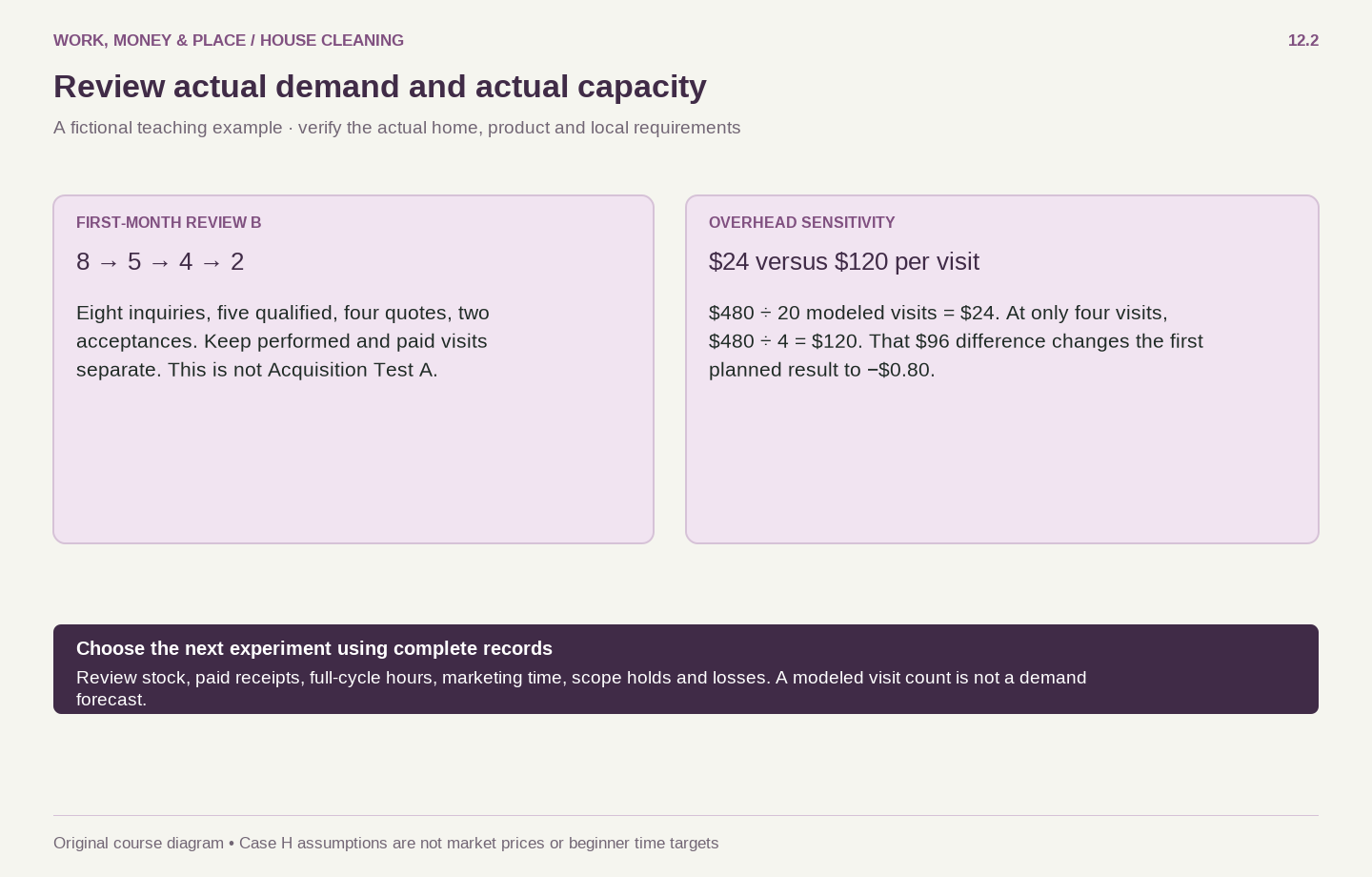
Choose the dates and records included in the review before calculating a rate. The separately fictional monthly cohort here contains eight inquiries, five suitable inquiries, four quotes, and two acceptances. It is different from the earlier acquisition test of 10, six, four, and two. Do not silently replace that earlier test or add both groups together if they may overlap. H14 should preserve the offer version, source, stage dates, and reasons that explain the counts.
For this monthly cohort, two acceptances from four quotes equal 50 percent, and two from eight inquiries equal 25 percent. Neither rate establishes completed or paid work. Reconcile accepted visits to actual service records and cleared receipts before making a revenue or cash conclusion. Record cancellations, holds, and work still pending. A short initial period is useful for identifying problems, but its small sample does not prove stable demand, a reliable conversion rate, or a year of future recurring income.
Compare actual performance with the preserved plan
The alternative first-visit actual keeps the $340 customer charge and $8.80 fee, but uses $16 stock, $12 fuel, and seven owner hours valued at $30, or $210. Equipment allocation remains $8 and overhead allocation $24. Its result before other business taxes is $61.20. Compare it with the original first-plan $95.20 before allowance: the unfavorable variance is $34. That difference is explained by $2 more stock, $2 more fuel, and $30 more owner-time value.
The plan's $20 allowance is a separate planning deduction. Comparing actual $61.20 with planned $75.20 after allowance gives a $14 difference, but that is a different comparison basis and must be labeled. Do not deduct the allowance again from actual expenses as if it were another supplier payment. H13 should use the dated static accepted-plan values; a later revised estimate must not rewrite the baseline. Investigate where the extra hour occurred before deciding that the next quote merely needs a higher price.
Explain why the bank increase is not the job result
On the alternative actual path, the bank begins at $290, pays $80 for stock and $12 fuel, then receives $331.20 net. Ending bank is $529.20, an increase of $239.20. Stock started at zero and closes at $64 after $16 use and no losses. Add that $64 inventory increase to the bank increase and subtract $210 owner-time value, $8 equipment allocation, and $24 overhead allocation: the same $61.20 management result is recovered. This is an isolated teaching reconciliation, not a tax return.
Before the receipt, $290 minus $80 minus $12 leaves $198. Preserving a $200 cushion therefore needs $2 extra in that alternative path. Do not hide the dip by looking only at ending cash. The planned repeat path ending at $793.90 follows the planned first visit, not this alternative actual. Real period records must also include intervening overhead payments, owner withdrawals, tax remittances, and other work; those events can materially change what is available for the next booking.
Test period assumptions before expanding capacity
The modeled overhead allocation is $480 divided by 20 visits, or $24 per visit. Twenty visits is a teaching allocation basis, not a demand forecast. In a separately labeled workload sensitivity, suppose the same $480 period overhead supports only four completed visits. The allocation would be $120 per visit, $96 more than the case assumption. Holding the other first-plan inputs unchanged would reduce $95.20 to negative $0.80 before allowance and other business taxes. Holding the alternative actual inputs unchanged would reduce $61.20 to negative $34.80.
That four-completed-visit sensitivity is not the eight-inquiry monthly cohort, and it is not a claim about actual Case H history. It answers a different question about allocation at a lower workload. Do not charge the full $480 again in a per-job management result after allocating it. Keep the period cash payment in the cash calendar and reconcile allocations with period costs. Review equipment use assumptions, acquisition attribution, helper obligations, and any unrecorded owner time in the same deliberate way.
Choose a narrow next operating plan
Use H24 to select the few changes supported by evidence. If access delays consumed time, improve confirmation and record the next result. If ordinary tasks repeatedly exceeded their budget, separate assessment error from inefficient sequence, inadequate practice, or changed condition. If unsuitable inquiries dominate, narrow the message before increasing spend. If cash fell below the cushion, change the funded timing or commitment rather than assuming the next customer will pay faster. Assign an action, owner, evidence needed, and review date.
Keep repeat interest separate from an accepted H21 agreement, and check full-cycle capacity before filling the calendar. Continue to protect household information and retain the records needed for open issues. A useful first-period review may lead to slower expansion, a smaller offer, or a pause to resolve a technical limitation. The aim is a service that can be repeated with sound records and appropriate boundaries. Neither a spreadsheet surplus nor completing this written course establishes hands-on competence or guarantees commercial success.
Put it into practice
Your assignment
Prepare a first-period decision report without mixing the monthly acquisition cohort, alternative actual, planned repeat, or overhead sensitivity.
Inputs
- Monthly cohort B: 8 inquiries, 5 suitable, 4 quotes, 2 acceptances; completion and collection counts are not supplied.
- Alternative first actual: price $340; fee $8.80; stock $16; fuel $12; owner 7 hours × $30; equipment $8; overhead $24.
- Alternative cash: opening $290; stock purchase $80; fuel $12; net receipt $331.20; closing stock $64.
- Separate overhead sensitivity: $480 period overhead over 4 completed visits rather than the modeled 20.
Your deliverable
H24 review linked to H13, H14, and H21, with labeled results, variance causes, cash dip, separate sensitivity, and one bounded next action.
Working forms: H13, H14, H21, H24.
Saved only in this browser when storage is available. Export this page separately and use fictional identifiers in practice.
Show the worked answer
- Monthly conversion: 2/4 = 50% quote-to-acceptance and 2/8 = 25% inquiry-to-acceptance. Paid and completed counts remain unknown.
- Actual result: $340 − $8.80 − $16 − $12 − $210 − $8 − $24 = $61.20. Variance versus planned before-allowance $95.20 is −$34 = −$2 stock −$2 fuel −$30 owner-time value.
- Ending bank $529.20; bank increase $239.20. $239.20 + $64 stock increase − $210 − $8 − $24 = $61.20. Minimum free cash $198; $2 extra preserves the $200 cushion.
- Separate overhead sensitivity: $480/4 = $120 allocation, $96 extra versus $24. First plan becomes −$0.80 and alternative actual −$34.80 before allowance/other taxes; do not combine its four completed visits with eight monthly inquiries.
- Next action example: use phase records to explain the extra hour, revise the supported future time budget, and test that change on the next separately assessed visit.
Show the self-check criteria
- Every calculation states its cohort, path, and comparison basis.
- Accepted, completed, paid, cash, inventory, and management result are distinct.
- The accepted estimate is preserved as dated values.
- The next plan names evidence, a limit, and a review date without an earnings promise.