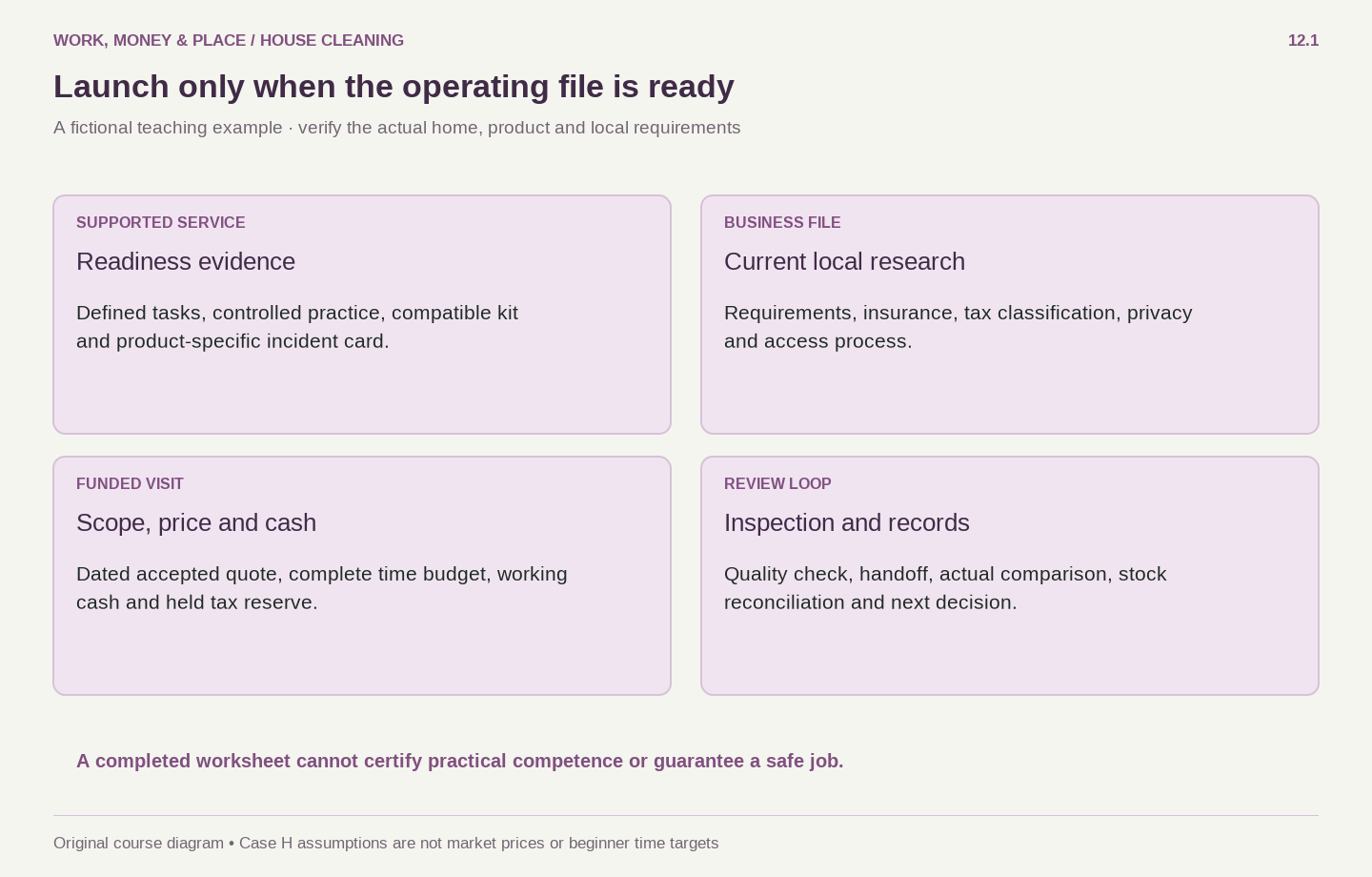
Make an evidence-based launch decision by checking service readiness, permissions, accepted documents, usable resources, and unrestricted cash before promising a paid visit.
Open the full-size diagram ↗
Example and worksheet
Use the separately labeled Case H teaching records, then create a dated record for your own assessed service. Fictional results do not establish practical readiness or local demand.
- Case H 01 · Understand the occupied-home service
- Case H 02 · Document the assessed package before pricing
- Case H 04 · Prepare the kit without counting it twice
- Case H 08 · Fund the visit before its receipt clears
- Case H 10 · Reconcile launch cash and the coverage floor
- Case H 12 · Preserve the accepted plan and transfer the method
Download the formula planner ↓
Example tab: First cash. Your blank tab: Your cash.
Open the downloaded workbook and select the named tab. Use the example for reasoning, then enter your own supported inputs in a separate blank Your sheet.
Treat readiness as a set of decisions
Finishing the lessons does not mean every task is ready for a real customer's home. H23 is a launch review that brings the earlier evidence together. Check that the offer remains routine occupied-home cleaning of assessed, reachable surfaces; that included tasks are supported by controlled practice; and that exclusions and stop conditions are clear. An unknown delicate finish, hazardous condition, or unresolved entry permission remains a hold. Do not turn a checked form into a claim of certification.
Review business requirements and coverage against the service you will actually perform. A submitted application, an insurance quote, or a draft policy does not prove active readiness. Keep the relevant source, confirmation, date, and outstanding action in H05. Where requirements depend on jurisdiction or worker arrangements, resolve them using the actual facts. The useful launch question is not whether the business looks established online, but whether it can carry out this specific agreement lawfully, safely, reliably, and with enough resources.
Reconcile the launch budget without counting the same cash twice
Case H's fictional launch funding is $560 reusable kit, $200 setup allowance, $480 first-month overhead cash, one $200 buffer, and $90 first-job float: $1,530 total. The $200 setup allowance is a planning amount, not a quoted government registration fee. The $480 overhead assumes the selected teaching business's period costs, not a standard insurance package. The $560 kit assumes a separately assessed purchase plan. Already owned transport is outside this purchase total; personal living costs are also not supplied.
The project bank opening of $290 contains the single $200 buffer plus the $90 float. The $80 stock purchase is already inside that float, along with $10 fuel. Do not add another $80 stock amount or another $200 buffer to the launch total. The kit, setup, and period commitments are funded separately from this isolated visit cash path. For your own launch, replace assumptions with actual quotes, usable owned items, cash commitments, and reserve needs. An owned vehicle can still have operating and replacement costs.
Check spendable cash and event timing
Enter total opening bank balance and opening held-tax reserve separately in H12. The base Case H opening reserve is zero, so its $290 bank balance is unrestricted before applying the chosen cushion. If a real business has held tax in its account, that portion is unavailable for buying supplies or paying an owner. List actual payments and cleared receipts in date order, including explicit zero fees where appropriate. A signed quote and an invoice marked paid are not substitutes for the clearing event.
In a separate readiness exercise, suppose only $80 of unrestricted cash is available and the modeled pre-receipt stock and fuel cost is $90. There is a $10 gap just to pay those two outflows. If the owner also requires the same $200 cushion, required unrestricted start is $290 and the gap is $210. These are different questions, not two estimates of the same shortfall. A decision to proceed must state the chosen cushion and actual funding source; hoping for a faster payment does not close a documented gap.
Rehearse the connected service record
Run a controlled practice cycle through the real workflow before a paid booking. Receive the fictional inquiry, assess zones and finishes, select supported methods, prepare the task list, estimate full-cycle time and costs, confirm access, load the kit, perform the practice, inspect, reset supplies, and complete the records. Use H02 to distinguish practiced competence from an unread task. Verify that clean and used supplies remain separated and that product instructions, incident information, and contact procedures are accessible when needed.
Then check the document chain: H06 survey, H07 count, H08 scope, H11 estimate, H12 cash plan, H15 confirmation, H17/H18 safety and compatibility records, H19 quality review, and H20 handoff. Each should identify the same scope version and exclusions. Preserve the accepted estimate as a dated static baseline for H13 actual comparison. A missing answer should result in a named action or a reduced scope, not a placeholder that quietly becomes a promise once the calendar is busy.
Choose a small first commitment and a review point
A launch can be deliberately limited to a service area, task set, and number of bookings the owner can support. Leave room for the full owner cycle, breaks, disruptions, follow-up, and unresolved finish questions. Do not book a second six-hour cycle into the same day simply because only the onsite portion is visible on the calendar. Check backup communication and what happens if the vehicle, equipment, or access arrangement fails. A small reliable commitment is sufficient for learning from actual performance.
Mark H23 proceed, revise, or hold and explain the evidence. Set a review after the first completed visit rather than treating thirty days as a guaranteed path to income. These written materials are free to use, with no course purchase or scheduled access expiry. It does not include business consulting, assignment grading, or approval of your launch. The decision must rest on your verified requirements, demonstrated scope, customer agreement, and actual resources.
Put it into practice
Your assignment
Complete a launch decision for the fictional model, then evaluate the separately labeled $80-cash readiness exercise.
Inputs
- Case H launch: kit $560; setup allowance $200; first-month overhead cash $480; one buffer $200; first-job float $90.
- The first-job float already contains $80 stock and $10 fuel. Transport is already owned and outside the purchase total.
- Separate exercise: only $80 unrestricted cash is available; pre-receipt outflows $90; chosen cushion $200.
- A surface is still unidentified and business requirements have not yet been confirmed.
Your deliverable
A completed H23 decision with a reconciled launch total, two clearly labeled cash-gap calculations, and named hold/revise actions.
Working forms: H23.
Saved only in this browser when storage is available. Export this page separately and use fictional identifiers in practice.
Show the worked answer
- Launch funding: $560 + $200 + $480 + $200 + $90 = $1,530. Opening visit bank $290 includes the same single buffer and float; do not add stock again.
- Separate exercise minimum outflow gap: $90 − $80 = $10. Gap while preserving $200 cushion: ($90 + $200) − $80 = $210.
- Hold the unidentified surface and leave it excluded unless a supported compatibility decision can be made.
- Resolve applicable business requirements and active coverage before the affected paid work. A finished workbook does not constitute authorization or certification.
- Choose revise/hold until the actual funding, agreed scope, practice evidence, and requirement confirmations support a proceed decision.
Show the self-check criteria
- The launch total and project-bank opening are reconciled without duplication.
- Cash gaps state whether the cushion is included.
- Open requirements and unknown surfaces stay visible.
- The launch decision cites evidence and has a review date.