Decide whether several real consenting customers, vehicles and locations support this deliberately narrow interior service.
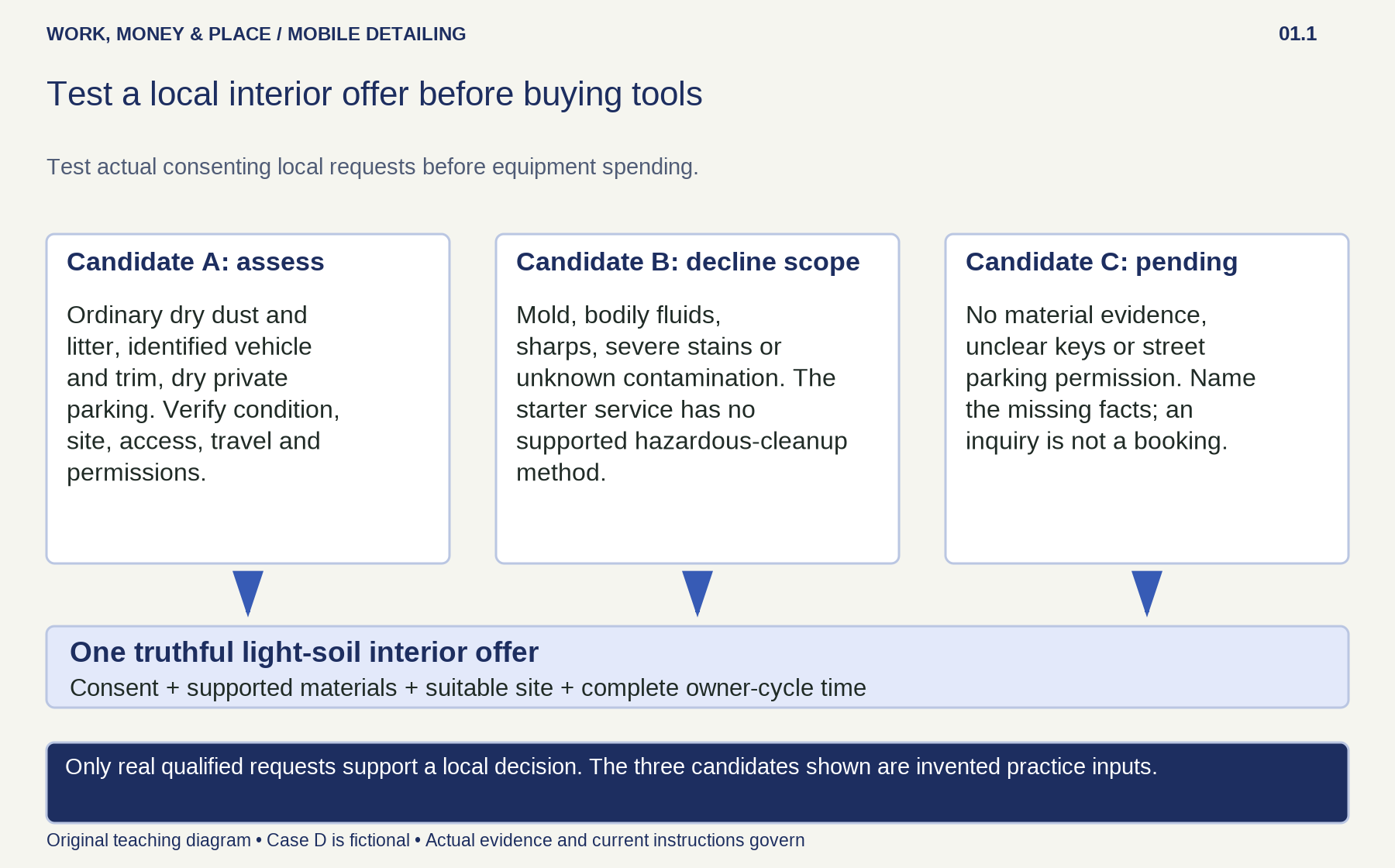
Open the full-size diagram
Example and working records
- D01 working form
- D04 working form
- Case D 01 · The limited interior offer
- Case D 02 · Intake, condition and customer control
- Case D 03 · The dry site and mobile load
- Case D 12 · One readiness decision
Relevant worksheet tabs: Launch, Time and costs. Preserve the fictional case and your accepted estimate. Enter supported own-job inputs and retain the evidence behind actual results; an unknown is not a confirmed zero.
Describe the actual result
This course starts with light-soil interior maintenance by one operator. Its selected example is a 2024 Tesla Model 3 RWD with black vegan-leather seats, intact original carpet mats and ordinary dry dust and litter. The supported offer uses dry vacuuming of accessible areas, soft dry dusting and a dedicated dry display cloth, plus only the limited water-compatible wiping that the actual instructions and method tests support. It is narrower than what many customers call a full detail.
Do not sell removal of greasy films, persistent seat marks, heavy embedded soil or odors under that description. Wet extraction, steam, seat or child-restraint removal/refitting, disinfection, conditioning, exterior washing and restoration are outside the core offer. A vehicle badge or the word vegan does not establish every material or instruction. Another model, year, modification or condition requires its own supported assessment before it enters an offer.
Compare current offers without treating packages as equal
Before spending, compare several current primary business menus in your actual area. The separate dated comparison uses Vancouver/Clark County and nearby Portland pages checked November 19, 2026. Northcrest advertises an Essentials interior starting price of $130, Ripple a sedan interior starting at $150, and Marko’s an Advanced sedan interior at $160. These are observations of different offers, not a market rate for our narrow scope.
Record vehicle size and soil condition, interior-only or combined work, mobile or shop delivery, tasks/exclusions, stated duration, add-ons, tax and unknowns. Ripple and Marko’s describe treatments broader than this course. Northcrest’s exact size mapping and package details were not established. Read each row’s limitations; never assume an undisclosed term is free or included.
Use this comparison to ask whether a customer values your actual limited result at a sustainable complete price. It does not justify Case D’s fictional $210. Preserve dated URLs/evidence in D01, then test genuine willingness through a consenting local-fit pilot. If scope or price does not fit, revise the supported offer or keep the equipment decision on HOLD.
Investigate actual requests with permission
Before an equipment commitment, use D01 to investigate several consenting requests in your reachable area. Ask for the exact vehicle, actual condition, desired result, parking location, access and willingness to consider this limited service at a complete quoted price. A useful pilot compares contrasting requests rather than asking whether people like clean cars. Three requests are a practical exercise choice, not a statistical demand test.
Keep the evidence honest. Distinguish customer descriptions and permitted photographs from conditions you have actually inspected. A photograph may hide tacky residue, damage or an inaccessible edge. Do not invent a customer because the exercise has blank rows. Research permission does not form an order or authorize entering a vehicle, moving it, handling keys or publishing an interior photograph.
Test the whole mobile appointment
Link the early D04 intake to a feasible location. Identify who can authorize work on the vehicle and the parking space, whether building or property rules allow a commercial visit, and whether the car can remain parked throughout. The operator does not drive or reposition the customer vehicle in the core scenario. Ask the customer to arrange suitable positioning before the appointment and to describe any access or security restriction.
Include preparation, travel, assessment/setup, cleaning and inspection, administration and the return-to-base cloth/equipment reset. Check suitable storage, charged equipment, a lawful ordinary-waste route and an appropriate laundry arrangement before calling the mobile model feasible. Available floor area and a customer’s permission are only part of that decision. Leave an unsupported surface, tool method or location pending rather than filling the gap with a stronger cleaner.
Make a bounded spending decision
Compare which requests fit the actual light-soil result. If most customers want stain treatment or exterior restoration, the pilot has identified a mismatch to solve before buying a kit. Do not conceal the mismatch by advertising a premium package and explaining the exclusions after arrival. Change the proposed service only when you can also support its method, costs, permissions and practical preparation.
Finish D01 with the proposed customer/vehicle/location combination, genuine evidence, named gaps and a decision to prepare further, HOLD or decline. The later product assessment and permitted rehearsal provide detailed method evidence. This first task decides whether that preparation is worth funding. Reading this course or using Case D does not prove local demand or physical competence.
Read the dated local menu comparison before equipment spending
Put it into practice
Your assignment
Compare a permitted local-fit pilot before equipment spending.
Inputs
- Compare several current primary local menus, dating the exact area, vehicle/condition, interior-only/mobile-or-shop scope, tasks, time, extras, tax and unknowns. Do not treat a published menu as a customer quote.
- Collect actual requests or mark them pending.
- For the fictional comparison, A has ordinary dry dust in the selected car and suitable private parking; B wants greasy-seat restoration; C cannot obtain parking-site permission.
Your deliverable
D01 dated local-offer comparison and consent-based fit decision linked to D04 evidence, before equipment spending.
Saved only in this browser when storage is available. Export this page separately and use fictional identifiers in practice.
Show the worked answer
- Keep A conditional on exact instructions, actual conditions and demonstrated method.
- Exclude B’s requested restoration from this offer; keep C on HOLD for site permission.
- Separate the fictional comparison from actual demand evidence and name the next action before spending.
- The dated published-menu comparison does not prove an equivalent package or $210 willingness. Keep actual customer demand pending until obtained, and test complete economics in 03.3 before equipment commitment.
Show the self-check criteria
- The advertised result matches the limited method.
- Vehicle, site, customer authority and complete mobile cycle are considered.
- Missing evidence stays visible.