Close the activity, location, customer-property coverage and tax questions for the actual interior service.
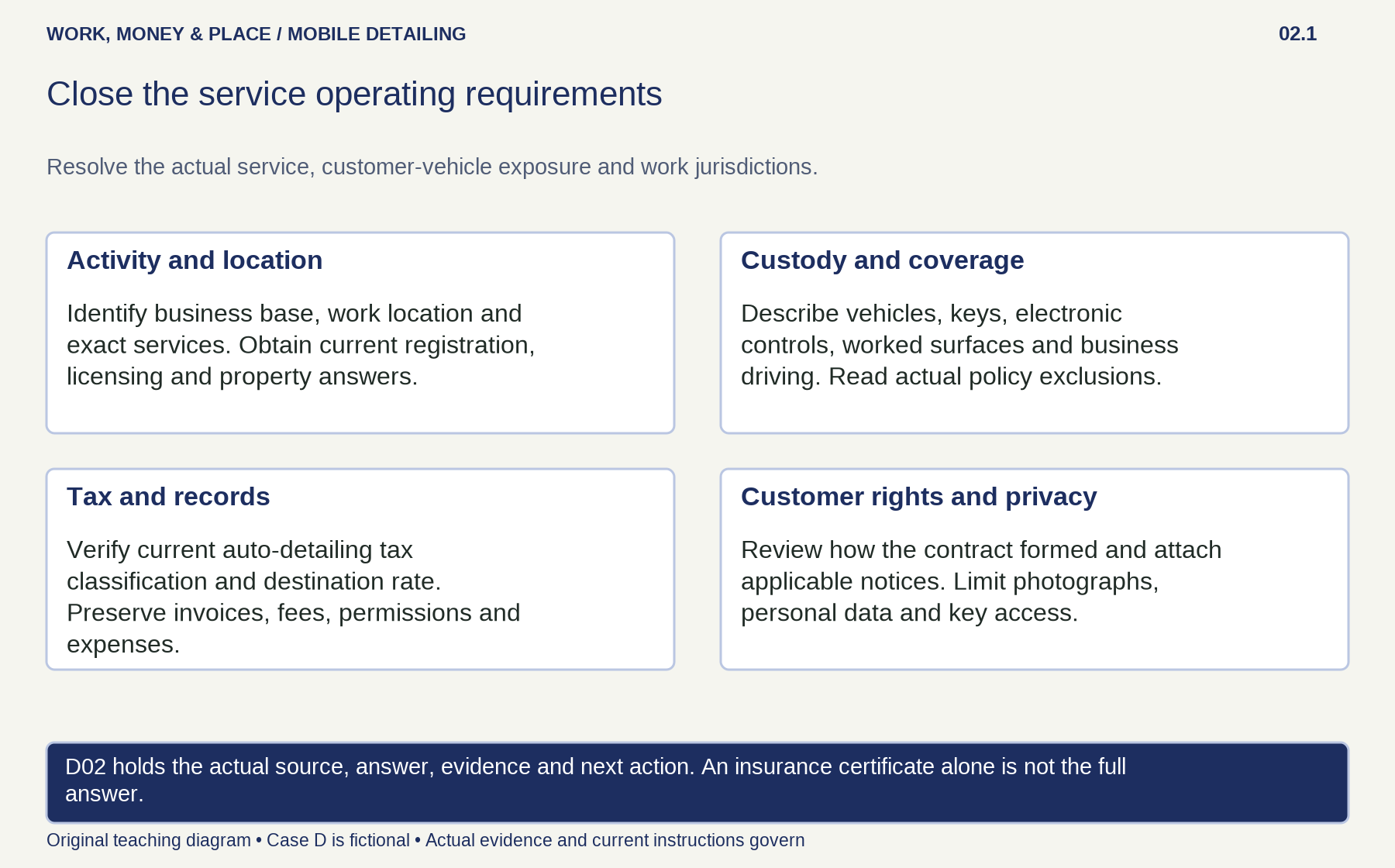
Open the full-size diagram
Example and working records
- D02 working form
- Case D 01 · The limited interior offer
- Case D 03 · The dry site and mobile load
- Case D 08 · Funded launch and dated cash
- Case D 12 · One readiness decision
Relevant worksheet tabs: Launch. Preserve the fictional case and your accepted estimate. Enter supported own-job inputs and retain the evidence behind actual results; an unknown is not a confirmed zero.
Describe the service to the responsible authority
Use D02 to describe mobile interior cleaning, the business base, storage/charging/laundry locations and each proposed work jurisdiction. Ask about the actual activity rather than an undefined auto business. A business identity filing, permission to operate at home and permission to work commercially at a customer’s parking location are separate matters. Keep the responsible authority, dated source, applicability, required action and status with the record.
The modeled Vancouver, Washington location illustrates why the actual boundary matters. Its city licensing information describes business licensing and separate home-occupation conditions. A Vancouver mailing address alone does not establish that every location is inside the city. Check the real base and service site. Record an active authorization or supported not-applicable conclusion; a submitted application and a course example are not evidence that the requirement is closed.
Ask about the vehicle while it is in your control
Give the insurer the exact work description: customer interiors, keys or access devices, components being cleaned, work near controls and electronics, ordinary business travel, equipment storage and any proposed vehicle movement. Ask expressly about care, custody and control of customer vehicles, worked-on property, alleged faulty work, accidental liquid or product damage and key loss. Keep the actual policy wording and answers; do not infer these outcomes from the phrase general liability.
NAIC explains that a business-owner package does not automatically include commercial auto and every other business exposure. Ask whether customer-vehicle coverage or an appropriate garage-related arrangement is needed for the actual operation and what exclusions, deductibles or conditions remain. This is a coverage question, not a promise that one named policy pays every scratch or correction. The core offer does not include driving, pickup/delivery or a paid helper. Adding those activities reopens the assessment.
Resolve tax and receiving arrangements
Washington DOR lists car washing and detailing among retail services supplied to consumers, and WAC 458-20-173 addresses cleaning personal property. Use the responsible authority to determine your actual service classification, sourcing, registration and current rate. Do not import a dealer-inventory resale rule into an ordinary consumer appointment. Case D’s customer-tax percentage is an arithmetic assumption, not a current Vancouver rate.
For this limited interior offer, identify the approved ordinary-waste and base laundry/reset arrangements. No onsite mat washing or disposal of collected liquid is included. Ask the relevant facility or utility about the actual residue and receiving activity if that is uncertain. Unknown contamination remains outside the routine service; an ordinary bin or laundry assumption does not authorize processing hazardous material.
Keep exterior expansion separate
D17 is an optional expansion decision, not a washing procedure or a cleared wastewater route. A later exterior offer needs its own vehicle/material method, site permission, drainage identification, collection equipment, actual receiving destination, transport/load assessment and applicable approvals. Portland’s mobile-washer program is a useful local example: collection and an approved discharge location are linked, and its authorization has activity limits. It is not nationwide permission or a laundry authorization.
Close D02 before an accepted job depends on the unresolved item. Keep service-specific answers in the required job file; use the optional WMP reference for general identity, insurance and tax background. Revisit only the affected requirement when the offer, base, insurer, receiving arrangement or work location changes. A completed form is a record of evidence, not a permanent operating permit.
Put it into practice
Your assignment
Audit an incomplete mobile interior operating file.
Inputs
- The owner has a registration but has not checked customer-parking restrictions.
- A general insurance certificate is supplied without review of worked-on vehicles or keys.
- The owner copies the case tax percentage and assumes a future exterior wash can drain anywhere.
Your deliverable
D02 applicability decisions and dated actions, with an optional D17 HOLD.
Working forms: D02.
Saved only in this browser when storage is available. Export this page separately and use fictional identifiers in practice.
Show the worked answer
- Check the actual service location and property rules.
- Obtain the applicable policy review for the described vehicle custody/work activities and verify actual tax treatment/rate.
- Leave exterior expansion unresolved until its separate method, site and complete receiving chain are supported.
Show the self-check criteria
- No permit, exemption, tax rate or insurance payment is assumed from the example.
- Customer/property permission is distinct from public operating requirements.
- Exterior expansion remains outside the core qualification.