Create an evidence-based surface and condition record before offering the light-soil interior service.
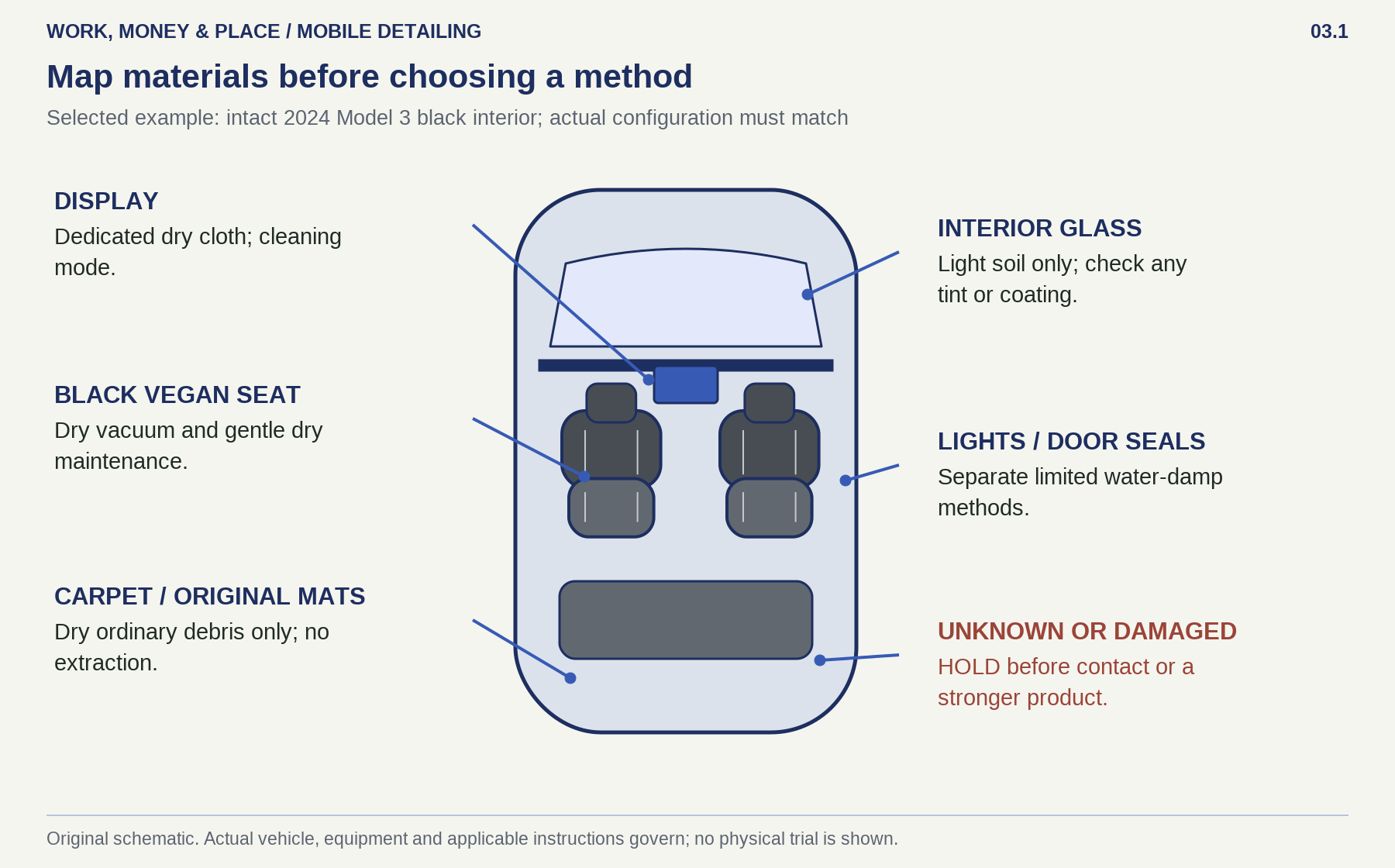
Open the full-size diagram
Example and working records
- D04 working form
- D05 working form
- Case D 01 · The limited interior offer
- Case D 02 · Intake, condition and customer control
- Case D 04 · Equipment, material methods and tests
Relevant worksheet tabs: Jobs, Your order. Read the fictional Case D assumptions beside the example. Use Your order for your own supported plan and actual observations; a financial result does not clear a physical HOLD. Record all preparation, travel, onsite work, administration and reset time.
Start with the interior you can actually support
The starter offer is light-soil interior maintenance by one operator: remove ordinary loose litter, dry-vacuum accessible carpet, mats and seats, gently remove loose surface dust, dry-clean displays with a dedicated suitable cloth, and finish only the supported light glass, lighting and seal work taught here. It does not promise removal of embedded stains, greasy films, odors, pet-hair mats, infection or damaged finishes. A customer asking for a deep clean needs an honest scope decision before a price.
Case D uses a fictional 2024 United States Tesla Model 3 RWD, black vegan-leather seats, intact original interior and the correct genuine 2024+ carpet mats. This is a bounded worked vehicle, not permission to transfer its care methods to another make, upholstery color, display coating or aftermarket tint. The drawings explain technique; none records a completed physical test.
Match the actual vehicle and its instructions
Ask the owner for year, model, market, interior material, accessories and relevant existing damage. With permission, record the useful configuration evidence without publishing the owner's VIN or personal data. Open the Manual app on the vehicle touchscreen with the owner. Tesla says this version reflects configuration and software; applicable release notes take precedence if they conflict. Save dated care locators in D04 rather than relying on a search title or model-year label alone.
Use D05 for one row per material: black seat, carpet, hard trim, display, interior glass, lighting and door seal. Record whether the surface is original, coated, tinted, repaired or unknown. Ask specifically about protective products or recent spills. An aftermarket film needs its own maker's care evidence. Unknown material or conflicting guidance remains HOLD for that surface; the owner's request does not establish compatibility.
Inspect without disturbing a hazard
Walk around the accessible cabin with the owner before opening bags, moving seats or switching on a vacuum. Note cuts, loose trim, lifted tint edges, damaged rear heater lines, damp carpet, torn upholstery and existing display marks. Photograph only with permission and enough context to identify the location. Describe what is visible; do not diagnose a leak, identify unknown powder or promise a repair.
Exclude sharps, bodily fluids, mold, pest contamination, hot ash, flammable residue, construction dust and unidentified debris. Do not reach into a seat gap or pocket by feel. If a child restraint obstructs an area, leave it installed and agree that area is excluded or reschedule after the owner's independent arrangements. This service does not remove or refit safety seats, seat belts, seats, airbag covers or electrical trim.
Agree what clean will mean
Ask the customer to remove valuables and loose personal items first. Agree which empty storage areas and glass panels are included; roof glass, cargo spaces and inaccessible areas are not silently added. The base result is visible loose-debris removal, reduced light dust and clear supported glass, with touched areas dry and original mats correctly returned. A small material check is part of preparation, not a promise that every stain can be removed.
Read the boundaries back to the owner and write accepted, excluded and unresolved items separately. Case D assumes suitable light soil and permission; it does not prove them for your first customer. If observation changes the scope, stop and agree the next decision before touching the unsupported area. Carry the accepted D04/D05 record into the appointment rather than restarting a generic inspection from memory.
Put it into practice
Your assignment
Classify three proposed surfaces for the bounded first order.
Inputs
- Original black seat has loose dry crumbs.
- Rear glass has an aftermarket film with no care information.
- The customer asks for odor elimination and removal of a sticky seat stain.
Your deliverable
A D04 intake and three D05 decisions with evidence, exclusions and unresolved actions.
Saved only in this browser when storage is available. Export this page separately and use fictional identifiers in practice.
Show the worked answer
- Accept gentle dry maintenance of the confirmed intact black seat after the planned check.
- Hold the tinted glass until its applicable film instructions and condition are resolved.
- Do not promise odor elimination or chemical stain treatment; clarify or decline those requests before quoting.
Show the self-check criteria
- Actual configuration and manual applicability are recorded.
- No unknown material or hazard is disturbed.
- The promised result matches the methods taught and excludes unsupported treatment.