Authorize a complete launch and pre-receipt funding plan that includes learning and reset needs without using protected household funds.
Open the full-size diagram
Example and working records
- D03 working form
- Case D 04 · Equipment, material methods and tests
- Case D 07 · Price, stock and reusable use
- Case D 08 · Funded launch and dated cash
- Case D 12 · One readiness decision
Relevant worksheet tabs: Launch, Your cash, Cash example. Preserve the fictional case and your accepted estimate. Enter supported own-job inputs and retain the evidence behind actual results; an unknown is not a confirmed zero.
Budget for readiness as well as equipment
Build D03 from the exact supported service and actual quotations. Include equipment with the intended commercial use, compatible power/charging arrangements, segregated reusable cloths, protection, clean/dirty transport, lighting and tools. Add registration/setup, appropriate coverage and the costs of external instruction and permitted practice. A cheap advertised vacuum price is not a complete operating budget.
Case D explicitly budgets instruction and practice access/materials; it does not treat a beginner’s learning as free. That cash provision does not show that instruction, permission or competent practice occurred. Close the practical gates before acceptance and paid work. Its Day 0 payments represent previously arranged startup obligations; a real provider requiring earlier payment must appear on the actual earlier cash date.
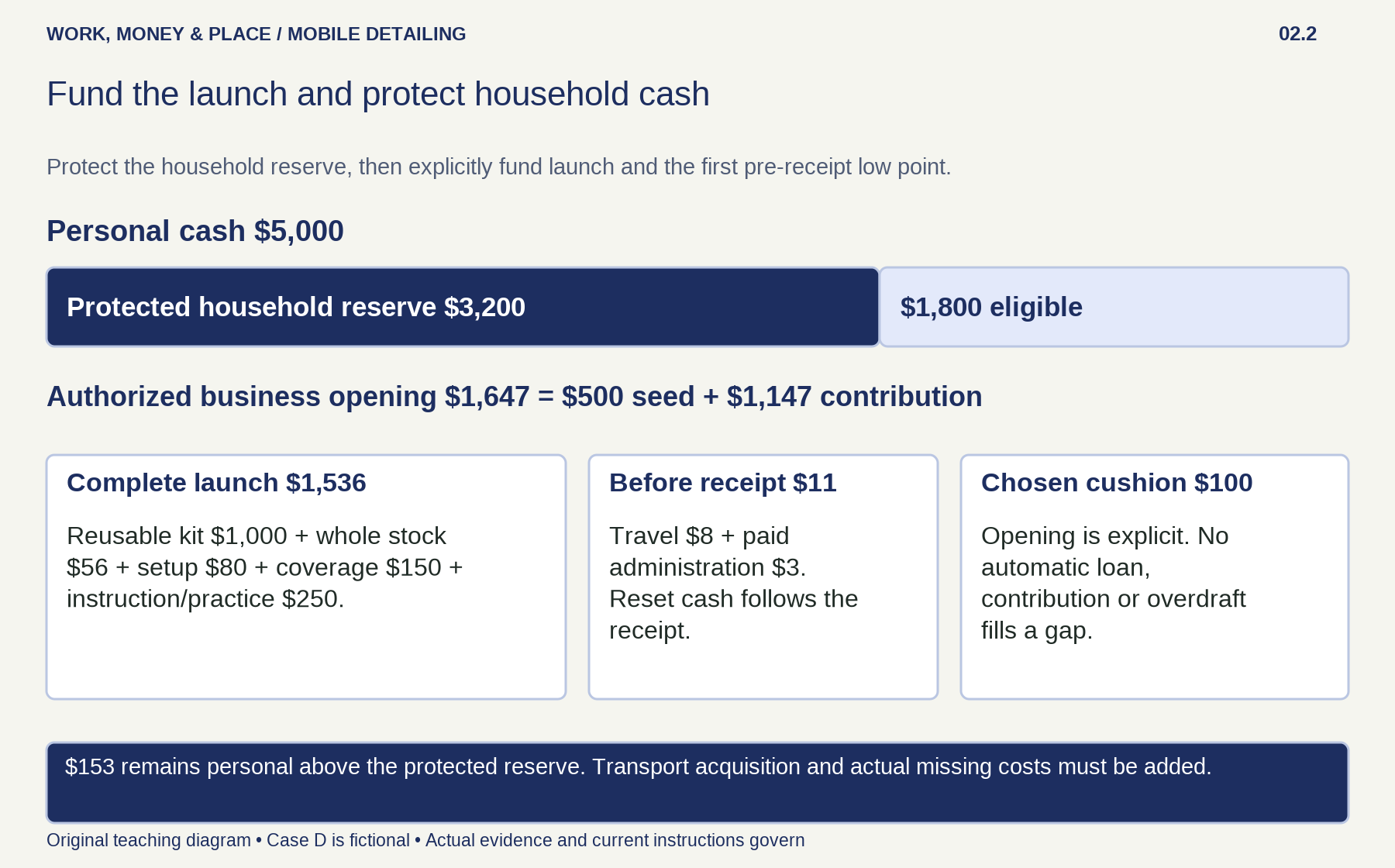
Case D's complete reusable provision is $1,000.00, including the commercial-intended Makita XCV11T system: XCV11 vacuum, two BL1850B packs and DC18RC charger, plus the stated cloth/protection/storage items. Whole unopened job-stock packs cost $56.00; setup $80.00, coverage $150.00 and learning/practice $250.00 bring selected launch cash to $1,536.00. The learning provision is $180.00 instruction plus $70.00 practice access/materials. All are invented landed budget envelopes, not current quotations or completed approvals.
The local offer decision comes first. Use the dated D01 comparison and the complete-price stress test in 03.3 before turning a kit budget into a purchase. If achievable supported prices cannot fund your owner cycle and chosen minimum result, an available equipment fund does not repair the business model. Reassess scope, route and actual costs or delay the commitment; do not bridge the mismatch with protected household cash.
Separate purchases from use
Whole reusable purchases and unopened stock packs consume launch cash. Later job consumption from that paid stock and a reusable-use allocation belong in the management cost record without another fictitious purchase. Reusable cloths are cleaned and reused under a supported arrangement, not counted as an entirely new pack consumed on every visit. Actual damaged or discarded cloths still need an honest replacement and stock/equipment record.
Allow for ongoing commitments, battery or filter replacement when actually needed, business communications, laundry/reset cash and the owner’s time. The case assumes an already-owned suitable transport vehicle; acquiring and adapting one is not silently financed by its kit allowance. Add acquisition, insurance, securement and operating costs if your actual business needs them. Replace every teaching envelope with a supported amount before committing funds.
Protect household money separately
List household essentials, dependable other income and the period you choose to protect. Keep that household amount distinct from the business operating cushion and any later after-margin reserve. Money already transferred into business cash cannot also remain available to pay the same household bills. A positive job margin is not a cleared customer receipt that can fund earlier startup purchases.
Record the authorized funding source, amount and availability date. Owner contributions are funding, not customer revenue. A forecast may expose a gap; it does not create a loan, overdraft or permission to use protected household cash. Choose a smaller supported launch, obtain genuinely available funding or delay the commitment when the complete plan cannot be funded.
The household example begins with $5,000.00. Two chosen months of $1,600.00 essentials protect $3,200.00, leaving $1,800.00 potentially available for business. Seed $500.00 plus an authorized $1,147.00 contribution fund $1,647.00, leaving $153.00 above the household protection uncommitted. That horizon is this fictional person's choice, not a standard runway recommendation.
Fund the mobile cycle on its real dates
Use the dated cash plan to identify obligations before collection and reset payments afterward. Do not put the same laundry payment in both the pre-receipt bridge and the after-appointment reset. Valuing owner preparation or laundry minutes helps price the service but does not itself pay wages out of the sole owner’s bank. A planned draw, if any, is a separate real cash event.
Finish with a spending decision tied to quotations, training/practice evidence, receiving arrangements and actual funds. Recheck if equipment compatibility, kit price, insurance or transport changes. Keep an unfunded version visible instead of rewriting a budget to appear ready. The case is a teaching model; it cannot approve your own purchase or establish a practical result.
Launch $1,536.00 plus first travel $8.00 and paid administration $3.00 require $1,547.00 before the first receipt. Opening $1,647.00 leaves the chosen $100.00 bank cushion. The first $3.50 reset payment occurs after that receipt, so it is not also added to the pre-collection bridge.
Put it into practice
Your assignment
Prepare the launch, household and dated funding decision.
Inputs
- List actual equipment, instruction/practice, whole stock and setup/coverage commitments.
- Record protected household needs, genuine available funds and the dates of startup, travel, administration and reset payments.
- Launch $1,536.00, including learning/practice $250; protected household $3,200 from $5,000 personal cash; pre-receipt operating cash $11 and chosen cushion $100.
Your deliverable
D03 supported launch and household funding record linked to Your cash.
Working forms: D03.
Saved only in this browser when storage is available. Export this page separately and use fictional identifiers in practice.
Show the worked answer
- Include learning/practice and any missing transport acquisition rather than assuming them free.
- Keep whole purchases separate from later use allocations and paid-stock consumption.
- Authorize funds only when actually available, and leave an unresolved requirement or gap on HOLD.
- Maximum potentially available business funding is $1,800; authorized opening $1,647 = $500 seed + $1,147 contribution leaves $153 uncommitted above household protection.
- $1,536 launch + $8 travel + $3 paid administration + $100 cushion = $1,647 required opening; first $3.50 reset is after collection, not counted twice.
Show the self-check criteria
- Household protection and the business cushion remain distinct.
- Training budget is not evidence of completed competence.
- No automatic funding or duplicate payment closes a gap.
- Equipment funding is conditional on local fit and a supported complete-price decision, not only cash availability.