Assess your practical evidence, full-cycle time, mobile workstation and transport before committing to customer appointments.
Open the full-size diagram ↗
Example and worksheet
Read the separately labeled fictional Case S records, then complete your own dated assessment. The example is not a supplier quote, legal determination, physical demonstration or beginner production-time guarantee.
Prove the whole task rather than one fast operation
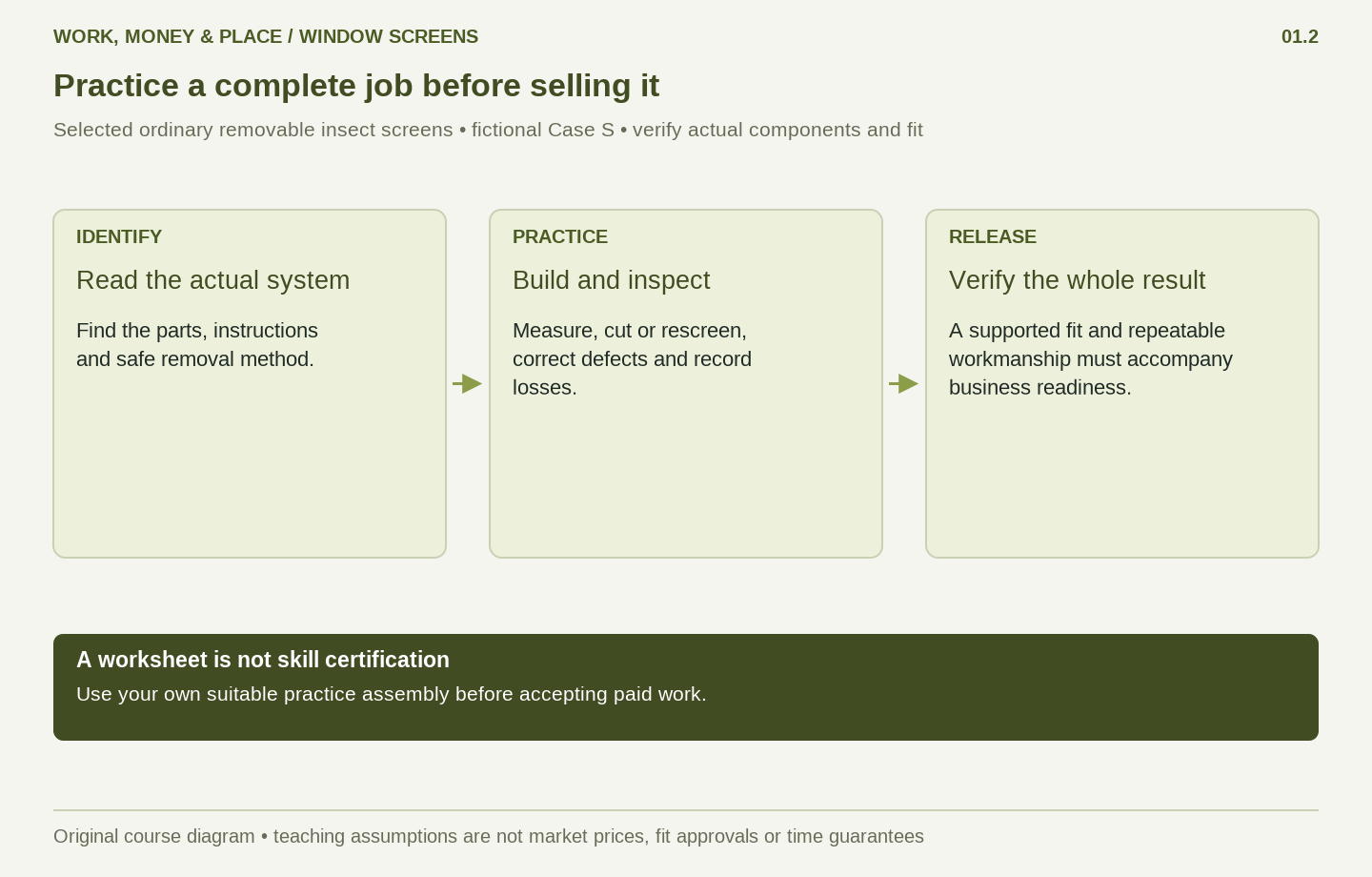
Knowing how to press spline into a channel is useful, but a paid screen visit includes many more decisions. You must recognize a suitable frame, establish the measurement convention, match components, avoid damaging the work and return the correct assembly to its opening. Practice those decisions on an identified system with permission before accepting customer work. A successful practice result on one system does not establish readiness for another profile, corner style, mesh or retaining arrangement.
Use S02 to record the practice item, exact components, instructions consulted, starting condition, process, correction and final trial fit. Include what did not work. If tension bows the frame or a new assembly does not seat, stop and identify the cause rather than recording only the successful attempt. Practical readiness means you can detect and respond to a failed result within the supported method. Reading the course, owning tools or receiving a customer approval does not replace that evidence.
Build a mobile workplace that can actually function
Lay out the whole workstation before buying a trailer or accepting a long route. You need stable support for the selected frames, appropriate cutting and screening tools, controlled storage, product-specific protection, a safe area for offcuts and room to move without entering a public walkway. Confirm how the tools will be used safely and how the actual equipment is secured for travel. A foldout table on unsuitable ground is not improved by putting more stock on it.
The customer must permit the work area, but permission alone does not establish safe conditions. Assess slope, wind, rain, lighting, traffic, children, pets and the route between the workstation and each accepted opening. Identify a clear stop condition for moving materials or using a cutting tool. If a sheltered location is unavailable when needed, revise the appointment. The business can remain small while still preparing a deliberate work zone; it does not need to imitate the equipment layout of a larger company.
Count the owner cycle and the calendar constraint
S03 records time before and after the visible repair. Include inquiry handling, assessment preparation, loading, travel, onsite setup, screen identification, the accepted tasks, inspection, cleanup, invoicing and stock reconciliation. Keep those categories distinguishable so you can learn where time is spent. A quoted appointment window is not the same as paid fabrication time. Time spent correcting a measurement error is still actual owner time even if you do not charge the customer for it.
The Case S time budget belongs to its exact fictional units and starting conditions. Treat it as a model to understand, not a beginner speed target. Record your own practice and early-job observations with explanations for differences. Also distinguish active labor from elapsed constraints: a delayed customer, weather interruption or missing component can block the next visit without creating productive cutting time. Leave realistic capacity between appointments rather than filling every available hour with an assumed number of completed screens.
Check transport and inventory as working capacity
A vehicle must carry the actual lengths, rolls, tools and finished frames without damage or unsafe loading. Determine whether your available vehicle can do that before calling its cost zero. Already owned transport still has operating, insurance and replacement considerations. Ask the appropriate insurer about actual business use and stock or customer-property custody. Do not assume a personal auto policy or a generic business policy covers every mobile activity simply because the tools fit inside.
Stock is also capacity. Carrying many colors is not useful if the needed profile, corner or retention component is missing. Start with the narrow supported system and maintain a verified opening inventory. Protect straight rails and mesh from damage and keep customer units distinct from your saleable stock. A damaged length or unusable offcut needs a recorded disposition. The later cost model distinguishes purchases, consumed stock and losses so an apparently well-filled vehicle does not hide expensive waste or unavailable parts.
Make a readiness decision you can defend
Compare your practice record, calendar and kit against the actual offer in S01. Mark each requirement ready, unresolved or outside the offer, with evidence and a next action. A beginner can choose more practice, a smaller service area, fewer appointment slots or a simpler component system. Those are operational decisions, not failures. The useful question is whether the next accepted visit can be completed and checked under the supported conditions, with a plan for the likely exceptions.
Do not solve an unresolved skill issue by promising a refund, relying on a customer waiver or hiring an unassessed helper. Do not solve a transport issue by carrying loose lengths unsafely. Complete a controlled rehearsal from packed vehicle to clean handoff and back to reconciled stock. Then review whether your records describe what actually happened. The course gives a method for that review; real physical practice and locally appropriate business preparation remain your responsibility before you offer the work to a household.
Put it into practice
Your assignment
Assess a first mobile-service readiness packet.
Inputs
- The operator can rescreen a practice frame but has not built and trial-fitted a new frame.
- A vehicle and folding table are available; usable support and secured stock storage have not been verified.
- The proposed offer includes both repair and new fabrication.
Your deliverable
S02 evidence record and S03 full-cycle capacity plan.
Saved only in this browser when storage is available. Export this page separately and use fictional identifiers in practice.
Show the worked answer
- Keep new-frame fabrication unresolved until a supported complete practice build and trial fit succeeds.
- Rehearse stable setup, secure transport, unit labeling, cleanup and stock count; record defects and corrections.
- Offer only tasks supported by the resulting evidence and reserve calendar time for the full visit cycle.
Show the self-check criteria
- No unsupported task is marked ready.
- Travel, loading and records are included once.
- Vehicle ownership does not substitute for secured loading or coverage checks.