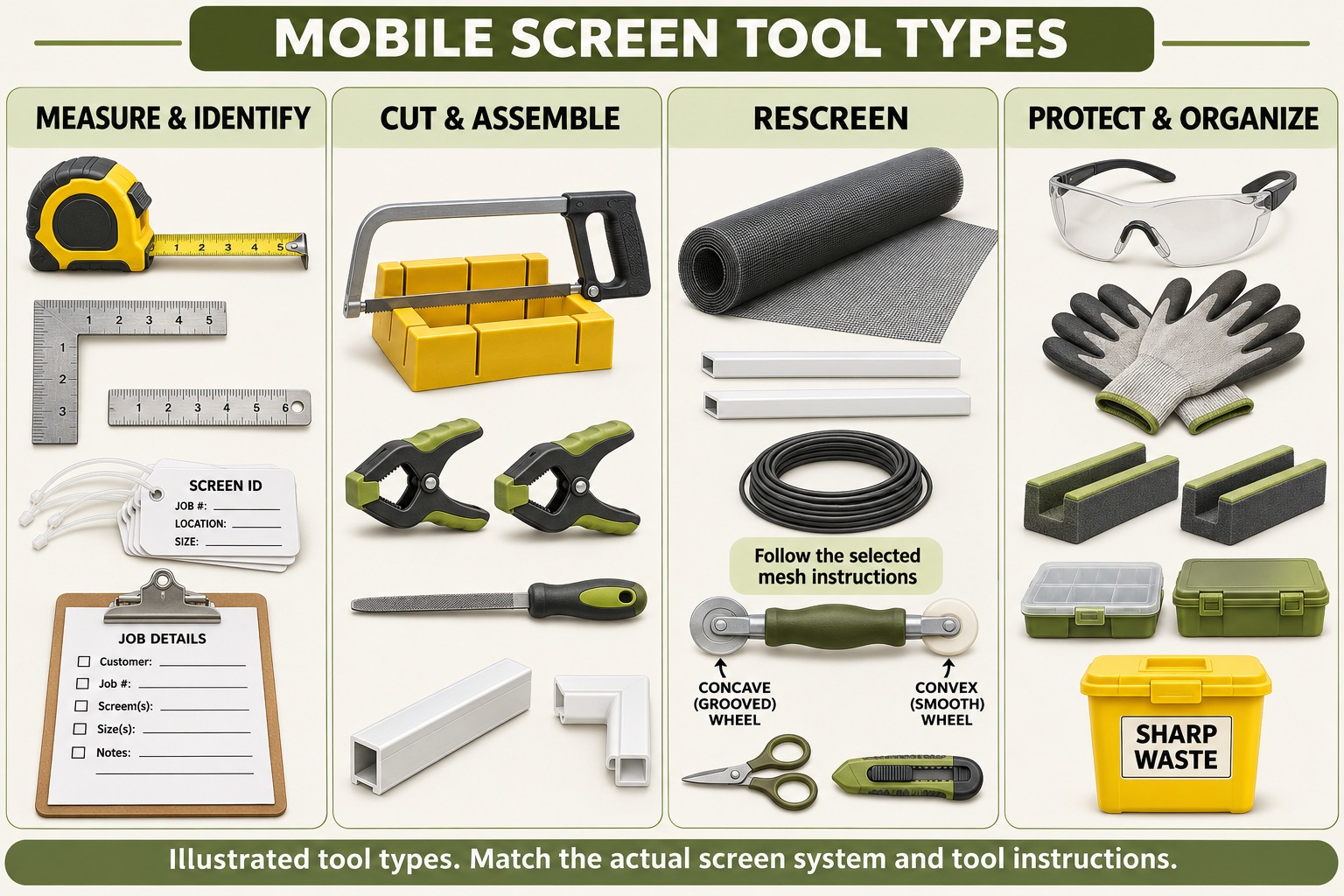
Open the full-size tool illustration ↗
Separate reusable tools from component stock
Case S uses a fictional $700.00 reusable-kit allowance and a $118.00 component purchase. The equipment share is $700 divided by 70 modeled uses, or $10 per visit. The first visit uses $56.14 of components and leaves $61.86; the stock purchase is paid once and is not another $118 job expense. These are teaching inputs, not current supplier quotes or tax-depreciation advice. Suitable transport is already owned and funded outside this case.
| Reusable-kit element | Fictional amount USD |
|---|---|
| Stable portable worktable and supports | 150 |
| Suitable frame cutting and deburring tools | 140 |
| Measuring, square and labeling tools | 65 |
| Spline rollers and controlled trimming tools | 65 |
| Reusable protective equipment | 70 |
| Separated parts storage and transport protection | 90 |
| Compatible cleanup equipment | 70 |
| First-aid package | 50 |
Keep matched parts and screen identities together
Tag each screen to its own opening, protect removed parts, and keep identified compatible stock separate from unknown or damaged components. Keep cutting and controlled trimming on the supported workstation, with the customer route clear. Inspect tools before use and contain sharp offcuts before transporting the kit. Never leave an unprotected window opening as a fall hazard.
Cost a whole kit once
The two selected new-frame kits include rails, corners, spline and pull tabs. Their complete teaching cost is charged once; those included parts are not purchased again in the takeoff. Bulk rescreen spline and mesh have their own measured issue records. Normal allocated trim and unexpected job losses remain distinguishable, and an unverified offcut is not automatically saleable stock.
Verify the component system before cutting
Use S18 to record the exact frame system, final outer-frame dimensions, supported rail deduction, mesh allowance, spline and existing retention. A matched example is not permission to combine unknown profiles or transfer its cutting rule to another kit. Put incompatible parts, uncertain retention or unsafe access on hold. Complete the S17 incident card for actual tools, site conditions and any product used.
- S09 · Tools Compatible Parts and Mobile Loadout
- S10 · Startup Funding Supplier Quotes and Stock Movement
- S17 · Mobile Workstation Safety and Incident Card
- S18 · Component Compatibility and Method Evidence
References: ST01, ST04, ST08, ST09, ST14, ST15, ST16. Read the scope and exact product instructions.