Build a location-specific registration and insurance file for the actual repair, fabrication, transport and fitting activities before accepting work.
Open the full-size diagram ↗
Example and worksheet
Read the separately labeled fictional Case S records, then complete your own dated assessment. The example is not a supplier quote, legal determination, physical demonstration or beginner production-time guarantee.
Describe the real work before asking which license applies
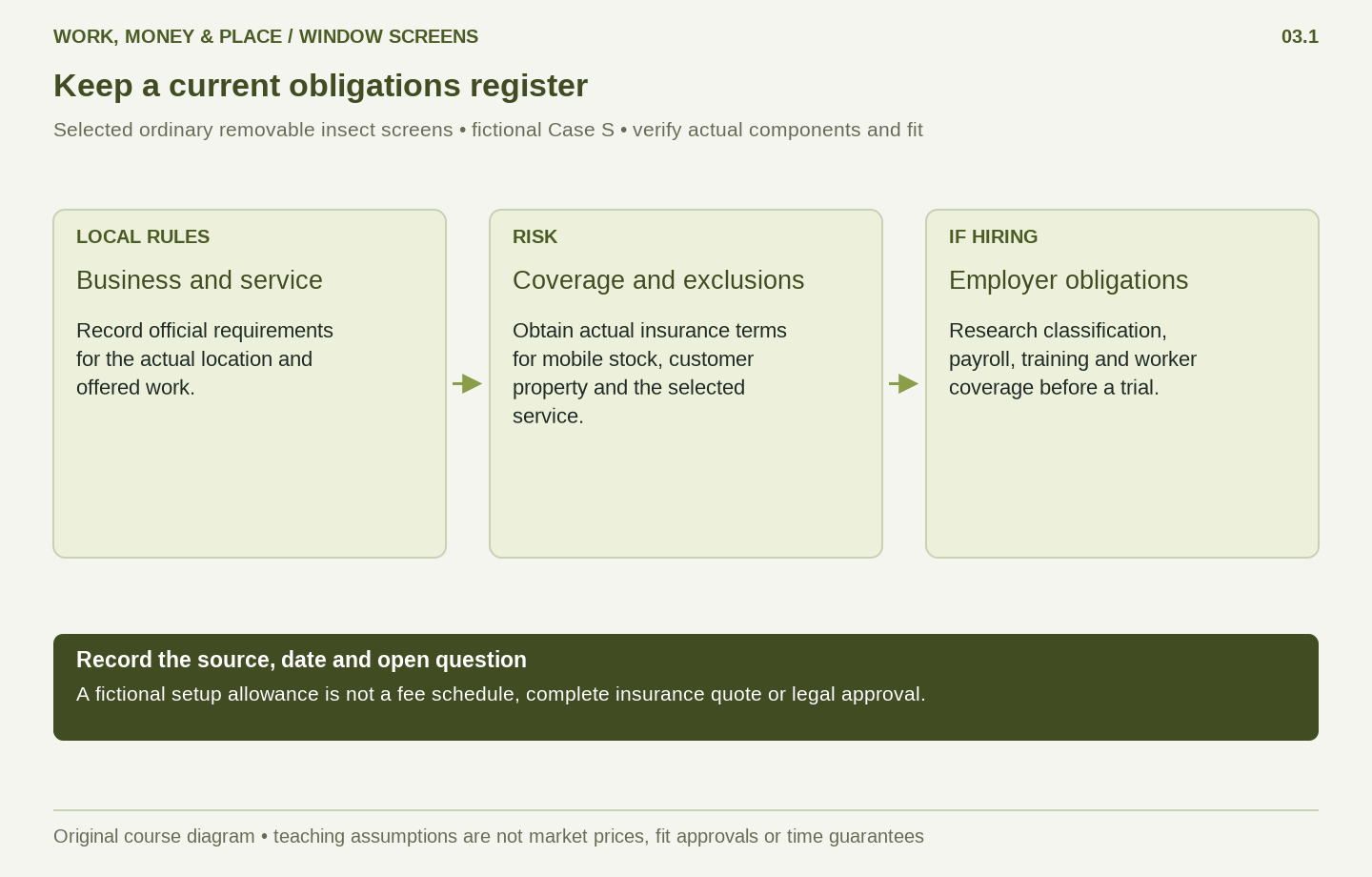
Begin the business-preparation file with a plain description of what you will actually do. Include mobile mesh replacement in accepted removable frames, fabrication of supported new rectangular frames, handling customer units, any removal or fitting and where each activity occurs. A name such as mobile repair does not settle whether an agency treats part of the work as retail repair, manufacturing, construction or something else. Give the agency facts it can evaluate instead of asking for permission to do an undefined business.
Use S05 to record the jurisdiction, agency, question, dated answer and remaining action. Include the business base, customer locations and any storage or fabrication location. A vehicle is not a substitute for a lawful business address or any relevant home-occupation, parking, zoning or city requirement. Do not copy a fee or approval time from another operator. Structure, name, locality and actual activities can change what is needed, and requirements must be checked against current official sources.
Separate general business registration from activity approval
The SBA launch framework directs a prospective owner to examine structure, registration, licenses, banking and insurance. In Washington, the Department of Revenue’s Business License Application and relevant endorsements are part of that preparation. Other approvals can involve a different agency. Completing one application is not a universal permission to advertise or perform every screen-related task. Keep the exact legal business name consistent across the documents and distinguish an application submitted from an active approval.
Construction contractor registration requires separate attention if the actual offer includes work within that scope. Washington L&I describes registration, bond and liability coverage requirements for construction contractors; its specialty definitions include screen-related installation categories. Those definitions do not by themselves resolve a particular removable-screen service. Present the actual removal, placement, fitting and any building attachment to L&I and obtain the appropriate determination. Do not rely on the customer supplying a ladder or describing the work as minor to avoid the question.
Ask insurers about the risks the offer creates
Prepare a coverage question list using the same activity description. Ask about mobile operations, damage to a window or household surface, customer screens in your custody, transport, tools and materials, completed work and any helper. Confirm exclusions, limits, deductibles and the handling of a reported incident. A certificate or a familiar policy name is not an answer to every question. Keep the insurer or qualified agent’s response with the actual policy documents and review changes before expanding the offer.
Coverage is not a substitute for a supported method, and it does not turn excluded specialty work into an acceptable task. Likewise, a customer waiver cannot repair an unsafe workstation. The Case S startup and overhead allowances are fictional budgeting inputs, not insurance quotations or proof that those amounts buy the required coverage. Obtain your own applicable quotes and record when a premium or renewal is due. Include transport business use even if you already own the vehicle and only carry small items.
Prepare financial identity and hiring obligations deliberately
Choose a suitable structure and determine applicable tax identification, banking and record requirements using current guidance and qualified help where needed. Keep the business records organized so receipts, stock and customer liabilities can be reconciled. Do not select an entity solely because someone claims it removes all personal risk or tax obligations. The course does not prescribe one entity for every learner, and the management planner is not a substitute for accounting or a filed return.
If you add help, research obligations before the first shift. Federal worker classification examines the actual relationship; a label or invoice is not decisive. Washington workers’ compensation has its own applicable tests. A registration number does not automatically exempt someone from coverage. Ask about payroll, wage, leave, unemployment, safety and insurance requirements for the real arrangement. The later helper lesson compares fictional operational costs, but it does not establish a lawful pay rate or complete employer burden for your location.
Create a readiness gate instead of a launch-date promise
Finish S05 with each action assigned to a responsible person and a next check date. Mark evidence as obtained, pending or outside the proposed offer. If installation classification is unresolved, do not quietly advertise the full fitting service as approved. Narrowing an offer also needs honest wording and agency confirmation where appropriate. An item in the course budget called setup is not evidence that registration, insurance or tax treatment has been resolved for your real business.
Before accepting work, confirm that required approvals are active for the actual activities and area, coverage is in place, documents use consistent identities and the customer process reflects applicable requirements. Retain the source and date rather than relying on a remembered phone conversation. Review the file when you change the location, add a frame system, start offsite production or hire. A careful file makes routine decisions faster later because it identifies what was resolved and what a proposed change would require you to reassess.
Include contract formation in S05: who requested contact, whether any sales presentation occurred at the home, how the complete offer was delivered and accepted, and the proposed start time. Research the matching federal, state and local cancellation requirements before work. A customer-invited presentation can still fall within the FTC rule; sending the final approval by email does not erase earlier personal selling. Record unresolved rights as a start-work hold, not a customer waiver. See SB14 and SB22–SB24.
Put it into practice
Your assignment
Prepare an obligations file for a mixed mobile service.
Inputs
- The offer includes rescreening, making two new frames and placing them in existing openings.
- The operator has a general business application but no documented L&I or coverage decision for those activities.
- The seller plans an in-person presentation at the home followed by an email acceptance and next-morning work.
Your deliverable
S05 questions, sources, evidence status and next actions.
Working forms: S05.
Saved only in this browser when storage is available. Export this page separately and use fictional identifiers in practice.
Show the worked answer
- Describe repair, fabrication, removal/fitting, customer-property custody and business/customer locations separately.
- Confirm DOR registration/endorsements and obtain the appropriate L&I determination for actual installation activities.
- Obtain applicable policy responses and active approvals; do not mark a budget allowance or submitted application as resolved evidence.
- Keep the cancellation review unresolved until the actual channel and timing are assessed; an email reply after an in-home presentation is not an entirely online transaction.
Show the self-check criteria
- No universal fee, one-week approval or blanket mobile exemption is promised.
- Unresolved obligations block acceptance of the affected work.
- Hiring classification and coverage are reviewed before help starts.
- The contract channel and any required cancellation notices and waiting period are checked before work.
Sources: SB02, SB09, SB10, SB11, SB04, SB20, SB14, SB22, SB23, SB24.