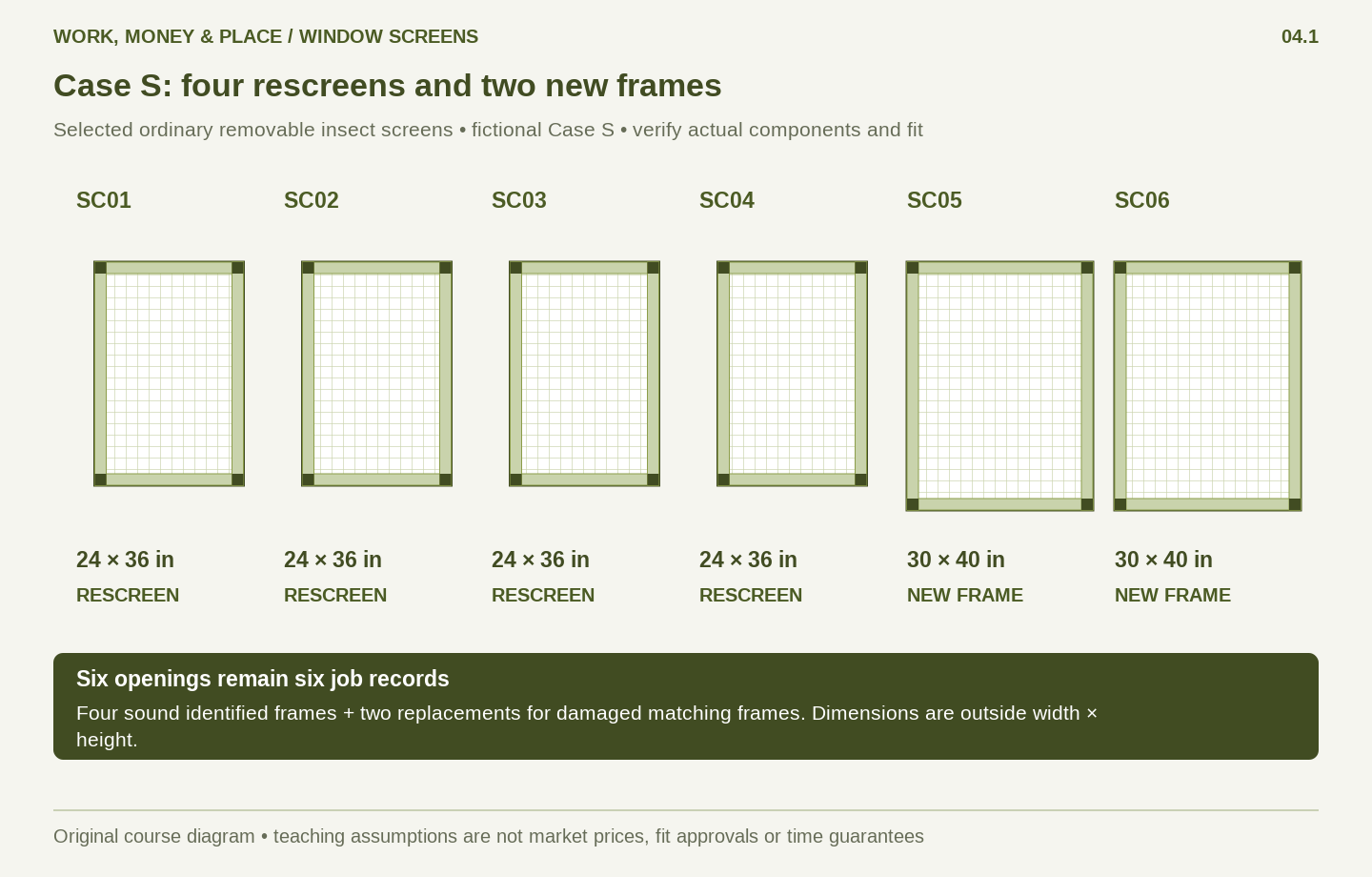
Create a traceable screen-to-opening inventory that separates four suitable rescreens from two documented replacement frames.
Open the full-size diagram ↗
Example and worksheet
Connect this lesson to the complete Case S records. Keep the fictional example separate from your own project.
Download the formula planner ↓
Example tab: First plan. Your blank tab: Your estimate.
Open the downloaded workbook and select the named tab. Use the example for reasoning, then enter your own supported inputs in a separate blank Your sheet.
Give the screen and its opening one shared identity
A screen is a fitted assembly, not just a rectangle of mesh. Begin at the customer’s opening, before collecting anything on the worktable. Assign an opening ID, record the room and a simple location description, and place the matching removable tag on the screen’s rigid rail. Keep tags away from mesh, seals, warning labels and moving hardware. Record which face points outward and which edge is the top. A reversible-looking frame can still have hardware that works in only one orientation.
Case S uses SC01 through SC06. SC01–SC04 are four existing 24-by-36-inch frames selected for compatible mesh replacement after inspection. SC05 and SC06 need new 30-by-40-inch frames to replace damaged matching assemblies. Those dimensions describe finished outside frames, width first. They do not describe the glass, visible mesh, window rough opening or metal rail cut length. The two new sizes come from documented original corner references and a verified opening assessment; they are not estimates taken from a photograph.
Describe the existing assembly before choosing work
On S06 and S07, identify the frame material, profile, color, corner construction, groove, mesh and retention arrangement. A profile description includes thickness and face shape; thickness alone does not establish that another corner or spline fits. Record pull tabs, springs, plungers, clips, crossbars and their locations when present. Photograph the relevant hardware with permission and without capturing private household details. Preserve original safety and product labels rather than replacing them with your business sticker.
In the fictional base case, the reusable frames are documented matching ADFORS assemblies with intact corners and grooves. Their compatibility record supports the selected standard fiberglass and replacement spline. The damaged assemblies provide reliable corner-to-corner references for the new sizes, but their damaged rails will not be reused. This evidence is an assumption within the teaching case. On a real visit, a customer’s statement that every screen is standard does not supply the missing product identification.
Separate damage categories that lead to different decisions
Look at each rail along its length and inspect the corners without pulling on the mesh. Note loose joints, twisting, crushing, corrosion, cracks, damaged spline channels and missing hardware. A hole in otherwise serviceable mesh can lead to rescreening. A damaged rail or failed joint requires a separately supported frame solution. A distorted window seat is a building or window issue; a new screen does not repair it. Mark the affected opening HOLD instead of trying to hide a gap with more mesh tension.
Document preexisting damage before disassembly. If a frame seems square only because the old mesh is pulling it into shape, its condition will need another check after removal. Keep the original reusable-frame decision provisional until that check passes. Do not offer straightening, corner gluing, drilling or improvised reinforcement as a free extension of the basic job. A different service requires its own supported method, equipment, price and customer agreement.
Assess access and protect the occupied home
Ask how each screen is meant to release and find the appropriate instructions or a verified product record before moving it. Confirm that the worker can support the frame from a stable floor or ground position throughout removal and return. Identify the sash, glass and other components that must remain untouched. Furniture, ladders, leaning outside and reaching across an unprotected opening are not solutions in this starter course. An inaccessible screen remains excluded even when it looks identical to an accessible one.
Arrange a clear route to the bench and a protected place for screens awaiting work. The household controls pets and keeps children away from both the tools and temporarily open windows. An insect screen must never be relied on to prevent a fall. Keep exits usable, and do not change window safety devices or the designed removal of a screen. Record any occupied-room restriction or weather condition that changes the visit; access belongs in the accepted scope, not in a private mental note.
Turn the inventory into a readable service package
Read the six-screen list back to the customer: four suitable existing frames will receive compatible replacement mesh; two damaged frames will receive supported new assemblies; the agreed existing opening retainers remain unchanged. Glass washing, window repair, security products and elevated work are excluded. State which observations are complete and which still need confirmation. A visit can include accepted rows and a held row without labeling the held row complete or charging it as finished work.
Practice the inventory on your own removable screen or a purpose-built training opening before accepting paid work. Trace its tag through the bench, quality sheet and return location. For Case S, check that six IDs create exactly four repair rows and two fabrication rows. No extra chargeable screen appears because an old frame and its replacement are both on the table. The inventory is ready when another person can locate every opening, identify the intended work and see why that work is supported.
Put it into practice
Your assignment
Build the six-screen inventory and classify an additional screen with a crushed groove.
Inputs
- SC01–SC04: documented sound 24 x 36 existing frames.
- SC05–SC06: damaged frames; verified replacement target 30 x 40.
- An additional upstairs screen has an unidentified crushed groove.
Your deliverable
Completed S06/S07 rows with orientation, evidence, task and status.
Saved only in this browser when storage is available. Export this page separately and use fictional identifiers in practice.
Show the worked answer
- SC01–SC04: rescreen, subject to post-removal condition check. SC05–SC06: supported new-frame fabrication with verified reference size.
- Additional screen: HOLD; it is outside the six-screen base scope. Obtain product identification and safe access before any separate offer.
- All six accepted screens retain individual IDs; the damaged source frame and its replacement share one opening ID.
Show the self-check criteria
- Six accepted openings, not eight assemblies.
- Dimensions labeled outside width × height; no guessed removal method.
- Crushed or unidentified groove is not approved by trying a larger spline.