Convert the six-screen scope into traceable component issue, stock balances and a complete owner-time record.
Open the full-size diagram ↗
Example and worksheet
Connect this lesson to the complete Case S records. Keep the fictional example separate from your own project.
- Case S 01 · Assess the six-screen mobile job
- Case S 04 · Stage the kit and reconcile component stock
- Case S 05 · Convert verified geometry into a cut and issue plan
- Case S 07 · Budget the full owner cycle
Download the formula planner ↓
Example tab: First plan. Your blank tab: Your estimate.
Study the filled First plan example tab without replacing its Case S data. Enter your own job in the separate blank Your estimate tab. Save a separate copy to experiment with a teaching example, and preserve a dated accepted baseline.
Start from six tagged items, not a vague average
Inspect First plan as the worked Case S example; do not overwrite it. For your own job, save a working copy and start in the blank Your estimate sheet. Open the accepted item schedule before entering costs. Case S has four sound, specifically identified 24 × 36-inch frames to rescreen and two 30 × 40-inch replacement frames made from the selected kit. These are final outer frame dimensions, not bare openings. Each item has its own opening tag, condition, safe access, included work and completion check. The screen count helps detect omissions; it does not prove equal materials, time or compatibility across all six items.
The two new-frame items use whole compatible kits. The four sound existing frames use separately verified bulk replacement spline. Do not put every component into every item simply because it appears on the tool list. Check the actual package contents, selected system instructions and safe fit before treating the takeoff as ready. Record an unknown or damaged component as a hold. An estimate cannot supply missing technical evidence or make an unsupported item suitable.
Separate purchased packs from normal issued material
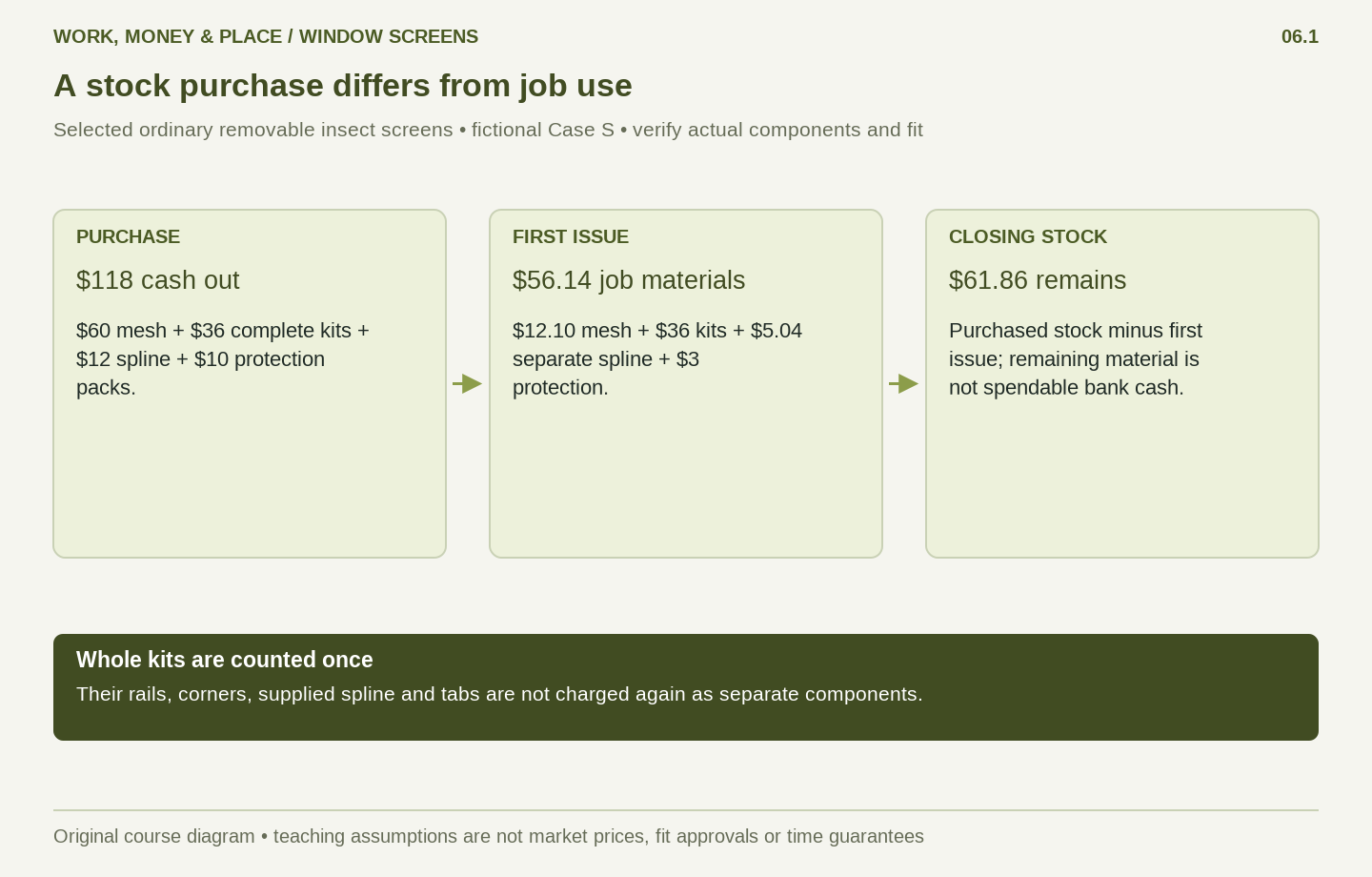
The fictional purchase is $118: 1,200 full-width inches of selected mesh at $0.05 per inch cost $60; two complete frame kits at $18 cost $36; 1,200 inches of verified bulk spline at $0.01 cost $12; and ten protection packs at $1 cost $10. These are invented landed costs. Real freight, purchase tax and permit treatment must be verified separately. Buying a roll does not mean the first customer consumed the entire roll.
Normal first issue is 242 full-width mesh inches, two kits, 504 bulk-spline inches and three protection packs. Their costs are $12.10, $36, $5.04 and $3, totaling $56.14. Kit rails, corners, supplied spline and tabs are already inside the $36 kit cost. Adding them again would overstate material consumption. Remaining stock is $61.86, with 958 full-width mesh inches, no unopened kits, 696 bulk-spline inches and seven protection packs.
Record normal trim and unexpected loss honestly
The mesh issue includes its normal side strips and trimming. The kit allocation includes normal rail cutoffs and residual parts. In this teaching method, those retained remnants carry no extra allocated value and cannot be charged again when used later. Keep their physical identity in the spare record anyway. A later usable remnant is not another paid full kit, and a narrow side strip is not additional full-width mesh remaining on the roll.
Unexpected loss is different. The actual alternative damages an additional 40-inch mesh blank worth $2 and discards a separate 126-inch spline piece worth $1.26. Record those $3.26 losses, their reason and the job assignment. All loss reduces stock. Only the supported job portion joins this customer’s cost. Do not label already counted normal trim as a second loss, or charge an unrelated company loss to this customer just to make the stock record balance.
Count the whole owner cycle
The first plan contains 210 owner minutes: 150 at the household and 60 offsite. The phases include setup and tagging, four rescreens, two new frames, trial fitting, customer inspection, cleanup, intake, quotation, loading, travel and financial records. At an internal $30 owner-hour value, 3.5 hours represents $105 of work. The value recognizes owner effort even though there is no employee paycheck to another person in the base case.
The time budget is fiction, not a novice speed requirement. During controlled practice, measure the complete supported process and record interruptions. If setup, a careful cut or a fit check takes longer, use the actual time. Do not tighten mesh further, skip a retention check or perform unsafe work to reach a spreadsheet target. Use the difference to improve later assessment, stock preparation and pricing rather than rewriting the accepted job history.
Connect quantities, cost and the visit record
Use S10 for material evidence and S11 for the estimate. In Your estimate, enter each complete roll or pack price, its units per pack and the number purchased in the purchase-basis block. Preserve opening quantity and its recorded carrying value. The workbook calculates full-precision average cost from opening value plus purchase value divided by available units. Never round cost per inch to cents. Round issue/loss money only; closing value retains the residual, and final depletion consumes it. This teaching allocation is not a prescribed tax method.
Before moving on, explain why $118 is the purchase payment but $56.14 is the planned job consumption. Point to the remaining $61.86 and identify what can actually be used on another supported job. Verify that each kit component appears only within the whole-kit allocation, that all six screen tags are covered, and that the owner-time total includes the trip and paperwork. These connections make the estimate reviewable before any selling price is accepted.
Test the quantity-to-cost link with a separate sensitivity copy. Change the complete 1,200-inch roll price from $60 to $72 in that copy’s purchase-basis block, rather than typing over the calculated unit cost. The same 242-inch issue costs $14.52 instead of $12.10. Job material cost increases $2.42 and the before-allowance result falls to $137.24 if the accepted price and other costs stay unchanged. Buying the same 1,200-inch roll now costs $72, so pre-receipt funding also increases $12. Those two effects are different: one uses the purchased quantity, the other the issued quantity. Keep the original accepted baseline unchanged and identify the new supplier-cost assumption before deciding a future price.
Put it into practice
Your assignment
Inspect First plan, then rebuild the component stock and owner-time record in blank Your estimate in a separate saved copy.
Inputs
- In the purchase-basis block enter opening value $0; mesh 1,200 inches per $60 roll × 1 roll, complete kits 1 unit per $18 kit × 2 kits, spline 1,200 inches per $12 roll × 1 roll and protection packs 1 unit per $1 pack × 10 packs.
- In the physical ledger enter opening quantities 0, normal issue 242 mesh inches / 2 kits / 504 spline inches / 3 packs, and confirmed loss 0. Full owner cycle is 210 minutes.
- In another saved copy, test a 1,200-inch roll priced at $50 with 40 inches issued; do not enter a rounded cost per inch.
Your deliverable
A dated saved working copy using the named blank Your worksheet, the connected forms and a short reconciled explanation. Keep the filled First and Repeat examples intact.
Saved only in this browser when storage is available. Export this page separately and use fictional identifiers in practice.
Show the worked answer
- Closing stock is $61.86: mesh 958 inches, unopened kits 0, bulk spline 696 inches and protection packs 7.
- 210 minutes ÷ 60 = 3.5 hours. Owner value is 3.5 × $30 = $105.
- Normal kit/offcut cost is included once. The separate $3.26 alternative actual loss is outside this accepted plan.
- The separate $50 roll test buys exactly $50 of stock. Full-precision $50 ÷ 1,200 allocates $1.67 to 40 inches and leaves $48.33; issuing all 1,200 inches consumes exactly $50.
Show the self-check criteria
- Units and opening/item tags are retained.
- Purchases and consumption are not double-counted.
- All phases total 210 minutes and no productivity guarantee is implied.
Sources: SF01, SF02, SF03, SF04, CASE-SC-01.