Price the defined work, account for gross-based receipt fees and test a tax-aware cost-coverage calculation.
Open the full-size diagram ↗
Example and worksheet
Connect this lesson to the complete Case S records. Keep the fictional example separate from your own project.
- Case S 02 · Write the complete scope and customer offer
- Case S 03 · Price the defined work and separate customer tax
- Case S 06 · Read the matching-scope management result
- Case S 09 · Model a separate next-customer route visit
- Case S 10 · Calculate launch funding and a tax-aware coverage price
Download the formula planner ↓
Example tab: First plan. Your blank tab: Your estimate.
Study the filled First plan, Repeat plan example tabs without replacing its Case S data. Enter your own job in the separate blank Your estimate tab. Save a separate copy to experiment with a teaching example, and preserve a dated accepted baseline.
Build a cost-covering planning price before comparing demand →
Write the accepted quote lines first
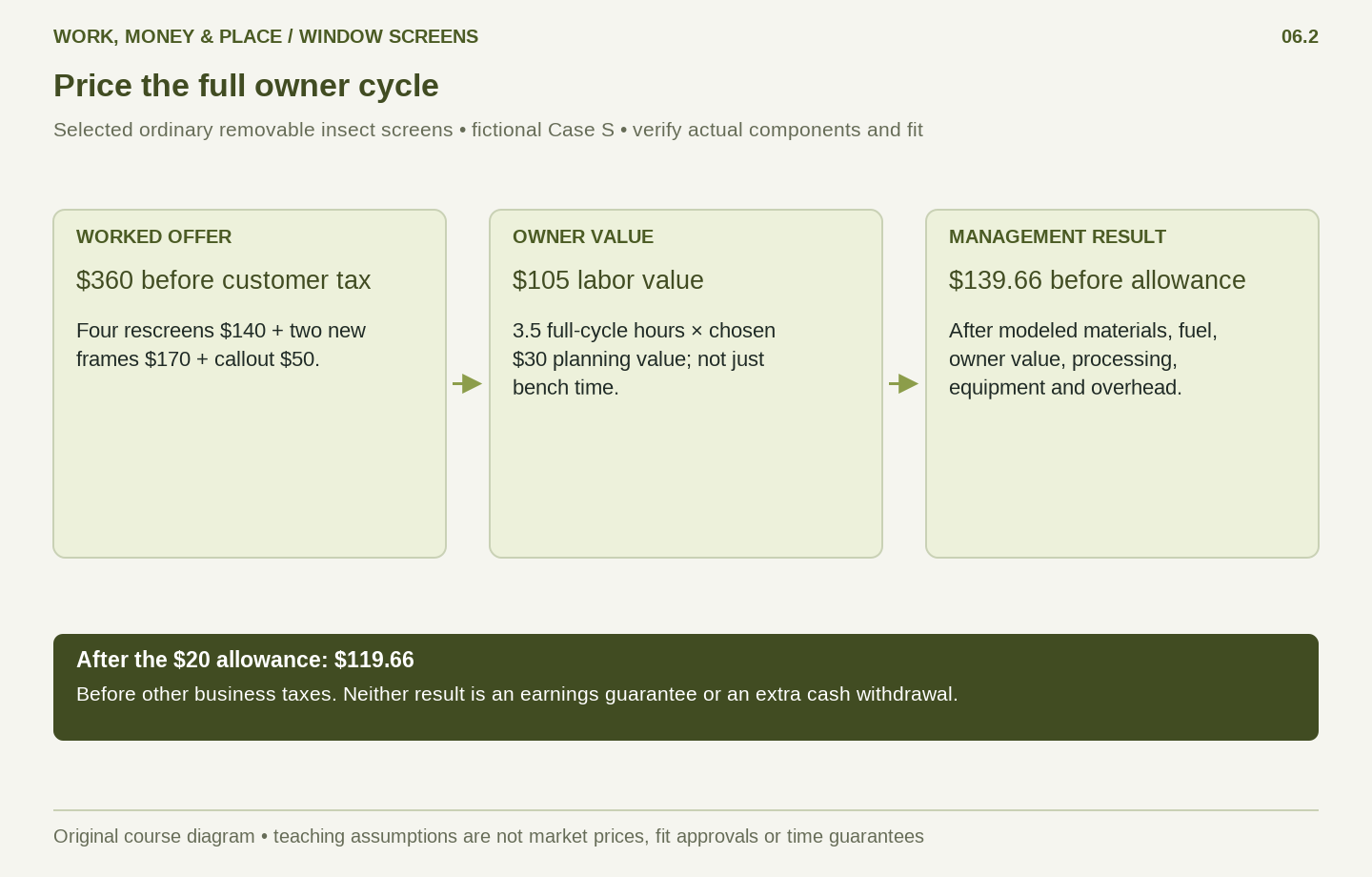
Read First plan for the completed Case S calculation. Keep it intact; use blank Your estimate in a saved working copy for the exercise and your own job. The Case S offer has three commercial lines. Four assessed rescreens at $35 produce $140; two supported new-frame items at $85 produce $170; one mobile callout adds $50. The service price is $360. Each line is tied to the actual scope and includes the agreed item work. The kit components are not additional customer extras after the new-frame line was accepted. A different mesh, damaged frame or extra item needs a separate assessment and written decision.
The planner records screen count as context and the three accepted line amounts separately. It does not multiply the whole quote by six. In Your estimate, retain quantity and unit-price evidence in the item schedule, then enter the agreed line totals and whole-pack purchase basis. The average cost per inch is calculated, not a cents-only money input. If a condition changes before work, revise the offer and keep its accepted version. Do not revise the old quote after completion merely because your actual costs differed.
Separate customer tax from revenue and gross fees
The case uses a fictional 10% customer-tax assumption to exercise the arithmetic. It is not a current city rate. Add $36 to $360 service price, producing a $396 customer total. Consumer repair and fabricated screen sales require current classification research for the actual location and activity. Washington repair/retail rules are relevant examples; manufacturing consequences, sourcing, permits and other business taxes need their own review. A tax rule for a different trade is not a substitute.
One hypothetical card payment costs 2.5% of gross plus $0.30. On $396 the rounded fee is $10.20, so bank receives $385.80. The fee depends on the tax-bearing gross, while service revenue remains $360. Round each receipt fee separately before adding them. A changed payment schedule or method changes that calculation. In the cash calendar, enter each actual fee from its payment record rather than applying one rate to both cards and cash.
Rounding is per payment, not only at the final total. In a separate receipt exercise, two gross payments of $10.10 at 2.5% plus $0.30 each produce $0.55 fees each, totaling $1.10. Combining their gross first and then rounding with two fixed fees gives $1.11 instead. The estimate uses separate receipt rows to avoid that hidden cent difference. If a customer changes the agreed schedule, recalculate the actual planned rows and reconcile gross to the quote. Do not change a fixed fee to force an aggregate shortcut to match, or describe the two different rounding methods as identical.
Read a price after the full modeled costs
Planned direct cost is $56.14 material issue, $14 fuel and $10.20 processing: $80.34 total. Full-cycle owner value is $105. Add a $10 reusable-equipment share and $25 business-overhead share. The $360 service price therefore leaves $139.66 before an allowance and other business taxes. A separate $20 allowance leaves a planned $119.66. Those are management results under fictional assumptions, not guaranteed take-home income or a complete tax calculation.
The allowance is a planning cushion, not an actual bill you deduct again if unspent. The owner value and allocation assumptions also need a rational basis. This case divides a fictional $700 kit across 70 modeled uses and $500 monthly overhead across 20 modeled visits. Neither denominator proves useful life or demand. At fewer paid visits the overhead share rises, and the same price may produce a weaker result. Test your own supported workload instead of copying these denominators.
Verify a coverage price with tax and rounding
Cost before processing is $210.14. A confirmed zero-fee cash receipt could cover that modeled cost at a $210.14 service price before customer tax, or $230.14 with the $20 allowance. This is cost coverage, not a recommended selling price. It also differs from pre-receipt funding because the job consumes only part of the stock purchased. Keep price coverage, project cash and customer tax as separate questions.
For this one-card example, tax increases the fee-bearing amount. A conservative provisional price is cost plus allowance plus $0.30, divided by 1 minus 0.025×1.10, then rounded upward to cents. Verify the rounded tax and actual gross afterward. At $216.40, tax is $21.64, gross $238.04 and fee $6.25, leaving $210.15. With allowance, $236.96 plus $23.70 tax has a $6.82 fee and leaves $230.14. Recheck rounding; this is not a universal or lowest-cent formula.
Test the minimum mobile visit against a different job
A separate customer has two suitable 28 × 36-inch rescreens. Two $40 item lines plus the same fictional $50 callout give $130 before $13 tax. Fee is $3.88. Material issue $7.68, fuel $10, owner value $45, equipment $10 and overhead $25 leave $28.44, or $18.44 after a $10 allowance. Smaller scope does not remove setup, travel, inspection and records. A minimum visit charge is meaningful only when the complete scope and cost support it.
Inspect Repeat plan for the completed separate-customer example. Rebuild a different proposed job in another saved copy of blank Your estimate, using S08 and S11 for its supported costs and realistic route. A volume price, callout or minimum must be understandable to the customer and compatible with the offer. Do not claim an automatic repeat discount or recurring repair income. The second household is a separate assessed opportunity. Decline or revise an offer that cannot cover the intended service without unsafe shortcuts, unsupported work or an unexplained loss.
Put it into practice
Your assignment
Inspect First plan and Repeat plan without changing them. Rebuild the quote and fees in blank Your estimate in a separate saved copy.
Inputs
- Enter first quote lines $140 rescreens + $170 new-frame work + $50 callout in Your estimate. Use the lesson 06.1 material record, 3.5 owner hours at $30, fuel $14, equipment $10 and overhead $25.
- Set fictional customer tax 10%, one planned receipt at 2.5% of gross + $0.30 and a $20 allowance. Save the accepted estimate with a date. Use another saved blank Your estimate copy for the separate $130 next-customer quote.
Your deliverable
A dated saved working copy using the named blank Your worksheet, the connected forms and a short reconciled explanation. Keep the filled First and Repeat examples intact.
Saved only in this browser when storage is available. Export this page separately and use fictional identifiers in practice.
Show the worked answer
- First customer total is $396 and rounded fee is $10.20. Result is $139.66 before allowance and $119.66 after it.
- Without allowance: $216.40 service + $21.64 tax = $238.04 gross. The $6.25 fee leaves $210.15.
- With allowance: $236.96 service + $23.70 tax = $260.66 gross. The $6.82 fee leaves $230.14. The separate next customer leaves $28.44 before allowance and $18.44 after it.
Show the self-check criteria
- Fees use gross and customer tax is not revenue.
- Every coverage candidate is recomputed with rounded tax and fees.
- Quoted lines match the accepted tasks and minimum-visit explanation.
Sources: SF01, SF02, SF03, SF04, CASE-SC-01.