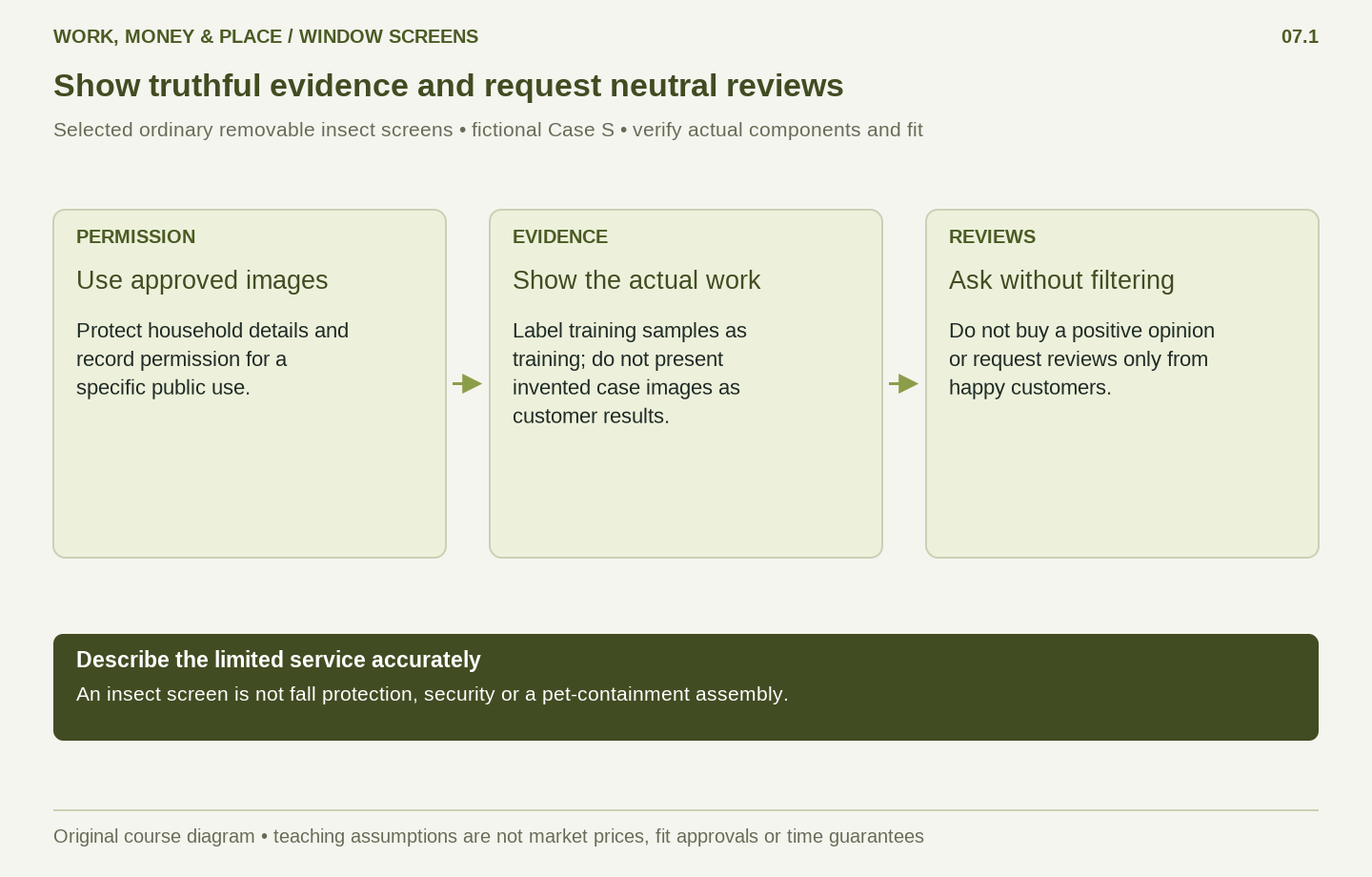
Create honest evidence for a bounded onsite offer and use a neutral review process without invented customers, incentive offers or review gating.
Open the full-size diagram ↗
Example and worksheet
Read the separately labeled fictional Case S records, then complete your own dated assessment. The example is not a supplier quote, legal determination, physical demonstration or beginner production-time guarantee.
Show the complete benefit your service can deliver
A useful screen-service page answers practical questions: which units you assess, whether you work at the property, what permits same-visit completion and how fitting is checked. A photograph of new mesh alone does not answer those questions. Explain that suitable existing frames can be rescreened and that compatible simple replacements require verified measurements and matched components. State the safe-access and stock conditions before a household assumes the visit can solve every problem involving a window.
Use S01 to draft one short service paragraph and a clear next step. Invite an assessment request with unit count, general task and relevant photos sent privately; do not request access codes in public comments. Separate assessment information from a final quote. If you mention the fictional Case S example, label it as a teaching case rather than your own completed project or a typical earnings result. Exact-looking prices are not evidence that a real household can receive the same scope for that amount.
Build a practice portfolio that survives close questions
Before you have paid jobs, document a controlled supported practice task with permission. Show the original frame condition, the identified components, the bounded work and the final check. Use comparable views and honest captions. A practice frame on a worktable should not be presented as a customer installation. A photograph of a rectangle leaning against a house is not proof that it has been trial-fitted or retained correctly. Describe what the image actually demonstrates and what the viewer cannot verify from it.
Original diagrams and generated illustrations are useful for explaining screen IDs, measurement conventions, part compatibility or the work route. Label them as illustrations. Do not use them as fabricated customer before-and-after evidence. Keep the underlying practice record and image rights available. When you later have actual customer work, obtain appropriate permission before public use and remove household-identifying information. A small portfolio with clear limits supports a stronger buying decision than an impressive gallery that creates a false history.
Explain trust with verifiable operating facts
Customers may worry about wrong sizes, damage during removal, missed appointments and whether a screen will fit after the repair. Address those concerns through the actual process: unit tagging, condition checks, an accepted task schedule, compatible parts and final trial fit. Say what you do if a part is unidentified or a frame is no longer reusable. Those explanations demonstrate your approach without claiming that no mistake can ever occur. A promise to fix any screen while the customer waits creates more risk than useful confidence.
Only claim registration, insurance, training, years of experience or warranties that you can substantiate and describe accurately. Do not suggest manufacturer certification because you use its components or link its instructions. An insurer response and active coverage are different from a generic badge on a website. If you offer a workmanship remedy, define appropriate terms and preserve mandatory customer rights; do not copy an unrelated fence warranty. Ordinary insect-screen work must never be advertised as fall protection, child safety or a security barrier without an entirely different supported product and service.
Invite genuine reviews without controlling the sentiment
Use the same neutral request process for genuine completed-service customers, subject to their contact preferences and the platform’s rules. Do not select only people who seem happy or send a public review link only after a positive satisfaction answer. That is review gating. The course company policy offers no discount, gift, free repair or contest entry for a review. This is a deliberately simple no-incentive policy, not a statement that every possible incentive is universally unlawful.
Ask for the customer’s own experience, positive or negative, without suggesting a star rating or supplying a fabricated endorsement. Do not ask a person who has never used the service to pose as a customer. Handle a fit complaint through the agreed service process whether or not a review exists, and never make a correction conditional on changing or removing a review. Some platforms restrict review solicitation itself; a neutral message does not override those rules. Keep the request optional and respect an opt-out.
Connect public proof to a measurable offer version
Keep a dated copy of the published service description, captions and next step in S14. Represent your real service area and customer-serving arrangement in any business listing. A home base with no customer-facing service should not be promoted as an invented storefront. Do not create fake local offices to look closer to every neighborhood. Platform visibility is a route to inquiries, not evidence of local authorization, practical readiness or sufficient demand at your planned price.
Review the questions your page produces. If people repeatedly ask for screen doors, elevated removal or unknown specialty hardware, improve the scope wording and intake examples. If they think mesh replacement includes rebuilding every bent frame, explain the distinction. Preserve the earlier offer so the next acquisition test can be interpreted. An honest portfolio is not merely a marketing asset; it reduces misunderstandings that otherwise consume quoting time, waste trips and put pressure on an operator to accept unsupported work.
Put it into practice
Your assignment
Draft truthful proof and a neutral review request.
Inputs
- You have one successful permission-based practice repair and no paid customer history.
- A generated measurement diagram is available.
- A proposed review survey sends the public link only to happy respondents and offers a free future repair.
Your deliverable
S01 offer paragraph and S14 caption/request record.
Saved only in this browser when storage is available. Export this page separately and use fictional identifiers in practice.
Show the worked answer
- Label the practice image as practice and the generated diagram as an illustration; neither is a completed customer project.
- Neutral invitation where the platform permits: If you choose to review our completed service, please describe your own experience, positive or negative. Reviewing is optional and no incentive is offered.
- Reject the happy-only route and free-repair incentive. Apply the neutral process consistently and handle complaints independently of reviews.
Show the self-check criteria
- Claims describe actual evidence and supported scope.
- No fake customer, manufacturer endorsement or safety-barrier claim is invented.
- No incentive, sentiment filtering or review gating is used.