Rebuild the entire Case S job and explain how scope, materials, management result and cleared cash reconcile.
Open the full-size diagram ↗
Example and worksheet
Connect this lesson to the complete Case S records. Keep the fictional example separate from your own project.
- Case S 01 · Assess the six-screen mobile job
- Case S 02 · Write the complete scope and customer offer
- Case S 03 · Price the defined work and separate customer tax
- Case S 04 · Stage the kit and reconcile component stock
- Case S 05 · Convert verified geometry into a cut and issue plan
- Case S 06 · Read the matching-scope management result
- Case S 07 · Budget the full owner cycle
- Case S 08 · Fund purchases and hold collected tax
- Case S 09 · Model a separate next-customer route visit
- Case S 11 · Reconcile actual usage losses and variance
- Case S 12 · Preserve the accepted plan and transfer the method
Download the formula planner ↓
Example tab: First plan. Your blank tab: Your estimate.
Study the filled First plan, First cash, First actual example tabs without replacing its Case S data. Enter your own job in the separate blank Your estimate, Your cash, Your actual tabs. Save a separate copy to experiment with a teaching example, and preserve a dated accepted baseline.
Preserve the accepted version before rebuilding
Read First plan, First cash and First actual as completed examples. Keep them intact. Rebuild this practice in blank Your estimate, Your cash and Your actual in a saved working copy. Begin with the six item tags and offer S-FIRST-01. Confirm four sound 24 × 36-inch reusable frames and two supported 30 × 40-inch replacements. The selected profile, reference dimension convention, original retention and safe access are documented before cutting. Keep the survey, accepted scope, quote and material record together. A financial result cannot validate an unknown frame system or prove that an insect screen safely fits a particular opening.
Save the accepted files with a date and version. The planner’s own-job estimate is a working calculation; it is not the legal agreement or the original measurement evidence. In Your actual, paste accepted inputs as values into the Plan column and identify their source copy. Save Your estimate before any sensitivity change; use a separate Your cash copy for alternative actual events. Changing a later offer must not silently rewrite the plan you are comparing with the completed job. Handle approved scope changes in a separate record.
Trace the cut plan into component issues
Each selected new kit supplies four 48-inch rails and its matching corners, spline and tabs. Without optional corner springs, the two new frames each need two 28.5-inch and two 38.5-inch finished rails. One finished rail comes from each stock piece; the short and long lengths cannot be paired on a 48-inch rail. The fictional measured kerf/offcut record accounts for all 384 stock inches across eight rails. Whole-kit cost remains $36, with no second charge for its included components.
Mesh follows two different supported instructions. Four rescreen blanks are 28 ×40 inches, while two selected-kit new-frame blanks are 31 ×41 inches. Full-width roll issue is 4×40+2×41 = 242 inches, costing $12.10. Bulk spline 504 inches costing $5.04 belongs only to the four rescreens; new frames use kit-supplied spline. Add three $1 protection packs and the $36 kits to reach $56.14 normal material use. Physical leftovers and their cost basis remain traceable.
Reconcile the quote to the management result
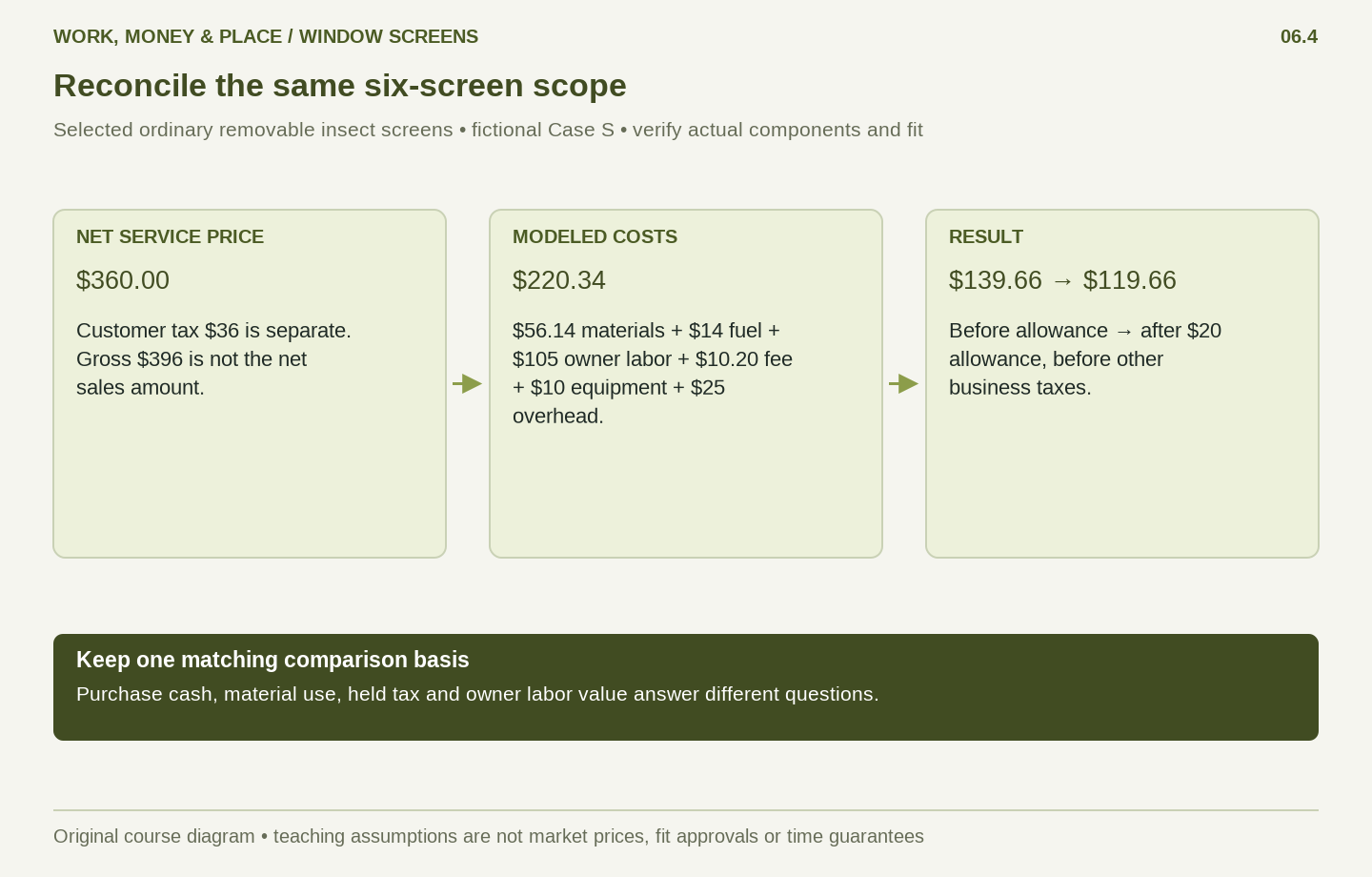
The accepted lines are $140 rescreens, $170 new-frame work and $50 mobile callout: $360 service revenue. Fictional 10% customer tax adds $36, making the gross receipt $396. The hypothetical 2.5%+$0.30 fee is $10.20. Planned direct cost is $56.14 materials+$14 fuel+$10.20 fee=$80.34. Add $105 owner value, $10 equipment and $25 overhead. The result is $139.66 before allowance and other business taxes, or $119.66 after $20 allowance.
Customer tax stays outside revenue and the processor fee uses gross. No additional kit-component deduction belongs in this calculation. The whole owner cycle is 210 minutes, including 60 offsite. Recompute both the dollar totals and the units instead of accepting a plausible-looking headline. A copied per-screen price or a count of hours at the table would not establish the same cost or scope. These values are fictional teaching inputs, not observed market prices or guaranteed earnings.
Explain the same job through bank and stock
Project bank starts at $332, pays $118 stock and $14 fuel, then receives $385.80 net of processing. Ending bank is $585.80, including $36 held tax and $549.80 free cash. Bank increased $253.80. Subtract $36 tax and add $61.86 remaining inventory to reach $279.66, the same $360 revenue less $80.34 direct cost. Subtract owner value, equipment and overhead to reach the same $139.66 result.
This bridge explains why buying a roll reduces bank immediately while using part of it reduces this job’s result. Do not deduct the $118 purchase and $56.14 consumption from revenue together. Likewise, equipment purchase and per-visit allocation belong to different records. Cash dates can differ from consumption dates. The model keeps them connected without pretending that bank balance, stock, gross receipt and profit are interchangeable measures.
Connect the job to launch funding without adding the same stock twice. The modeled launch needs $700 reusable tools, $200 setup, $500 first-month overhead cash, one $200 buffer and the $132 stock/fuel bridge, totaling $1,732. Stock is already inside that bridge. Suitable transport is already available, while vehicle acquisition and household living costs are outside this total. Paying for the reusable tools belongs to launch cash; the $10 job equipment share belongs to management cost. A change in either assumption must be tracked in the appropriate record rather than added to every job indiscriminately.
Test the alternative and transfer the method
The alternative first actual loses an additional 40-inch mesh blank worth $2 and 126-inch spline piece worth $1.26. Normal issue remains $56.14; job material cost becomes $59.40 and closing stock $58.60. Fuel $18 and owner 4.5 hours increase the other costs. The same revenue and fee leave $102.40. The $37.26 unfavorable before-allowance variance is fully explained by $3.26 loss, $4 fuel and $30 owner value, not a changed accepted price.
Its bank is $581.80 because only fuel creates an additional cash payment within the modeled path. Tax reserve remains $36 and free cash $545.80. The separate next customer is another assessed two-screen job, not recurring repair income or a continuation of the alternative actual. Before using your own record, replace scope, components, supplier costs, times, tax, payment methods and dates with supported evidence. Finish by explaining each difference without relying on hidden assumptions.
Inspect Repeat plan and Repeat cash, then rebuild the separate next household in another saved blank Your estimate and Your cash copy using its own assessment. Its two 28 × 36-inch frames require different mesh blanks and bulk-spline allowances from the first four rescreens. Material issue is $7.68, not half the first job’s $56.14, because no new kits are used. The $130 price and $3.88 fee leave $28.44 before allowance. Existing stock supplies this visit, but using it still costs money. Carry the planned first bank and tax reserve separately and include both customers’ $49 held tax before describing the $665.92 unrestricted balance. This does not imply a repair subscription.
Put it into practice
Your assignment
Inspect the completed First examples, then reconcile this practice in blank Your estimate, Your cash and Your actual using a separate saved working copy.
Inputs
- Rebuild all six tagged items, $360 service plus $36 tax, $118 purchase and $56.14 normal issue in Your estimate and Your cash. Save the accepted estimate with a date before changing any inputs.
- Paste the accepted plan values into Your actual, then enter the alternative actual: normal issue $56.14, additional job loss $3.26, fuel $18 and owner hours 4.5. Test the actual cash events in another Your cash copy; do not replace First cash.
Your deliverable
A dated saved working copy using the named blank Your worksheet, the connected forms and a short reconciled explanation. Keep the filled First and Repeat examples intact.
Working forms: S07, S08, S11, S12, S13.
Saved only in this browser when storage is available. Export this page separately and use fictional identifiers in practice.
Show the worked answer
- Planned direct cost is $80.34. Management result is $139.66 before allowance and $119.66 after it. Closing stock is $61.86.
- Bank $585.80 − opening $332 − held tax $36 + closing stock $61.86 = $279.66 contribution before owner value, equipment and overhead.
- Actual result is $102.40 and unfavorable variance is $37.26. Actual bank $581.80 includes $36 held tax and is distinct from profit.
Show the self-check criteria
- Each quoted item, stock component and phase has a source record.
- Cash and result reconcile without double-counting purchases.
- The static accepted baseline is preserved.
Sources: SF01, SF02, SF03, SF04, CASE-SC-01.