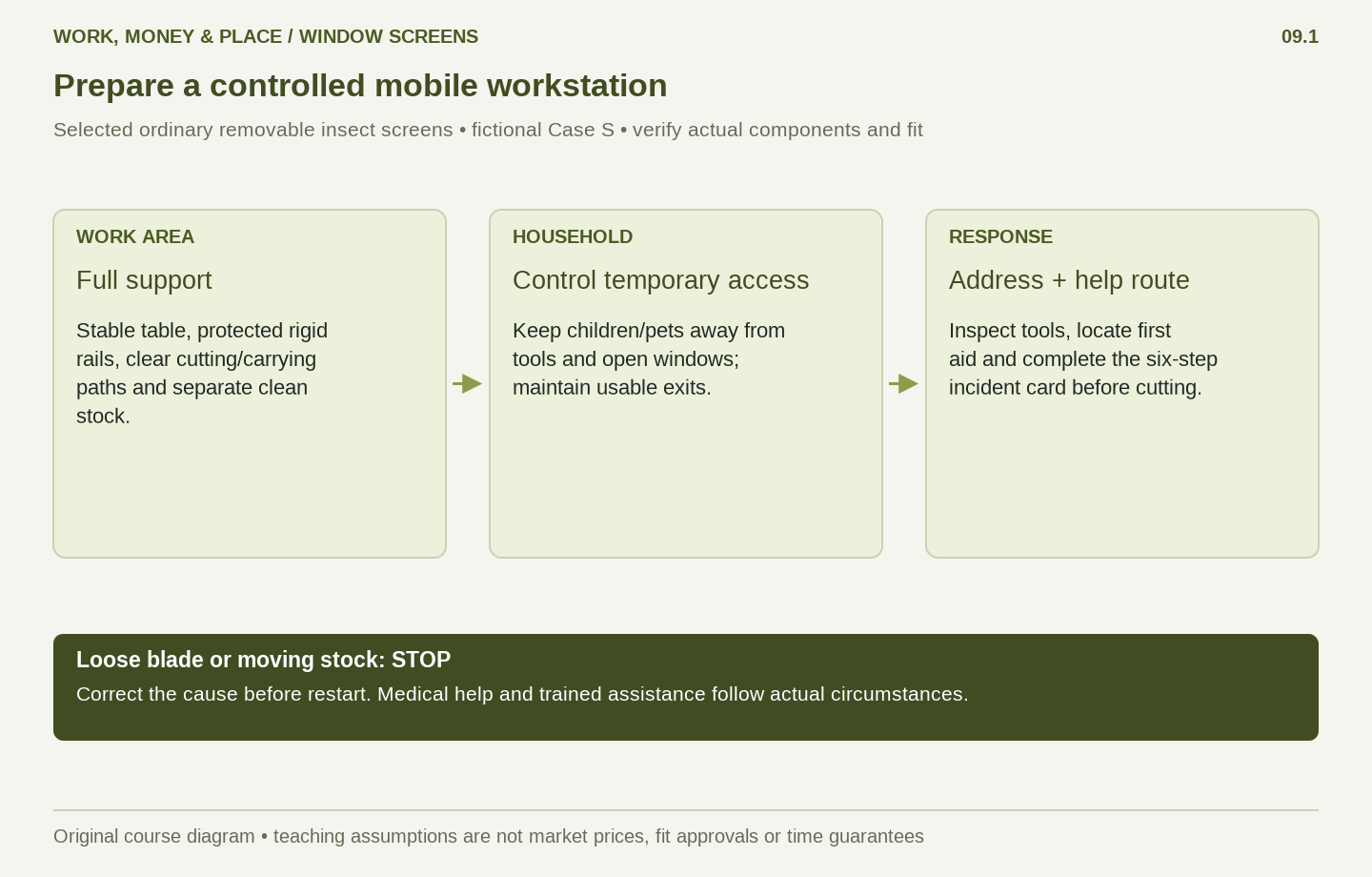
Set up a stable protected mobile workstation, preserve screen identity and prepare a usable incident response before removal or cutting.
Open the full-size diagram ↗
Example and worksheet
Connect this lesson to the complete Case S records. Keep the fictional example separate from your own project.
Confirm the visit conditions before unloading
Walk the agreed work route with the customer before opening your tool case. Confirm the six opening IDs, work area, vehicle location, household access and pet arrangement. Look for changes since the survey: rain on the table location, furniture blocking a window, a damaged pane or an occupied room can change what is feasible. Compare those conditions with S06 and the accepted scope. A familiar address does not make today’s access automatically suitable.
Case S assumes that all six ordinary removable screens can be handled from stable floor or ground positions, with their release methods already identified. It does not authorize ladders, exterior reaching, glazing work or alterations to the opening. Keep children away from temporarily open windows as well as the bench. When a condition has changed, discuss the affected row and update its status before proceeding. Do not remove a screen merely to see whether a difficult return will somehow be possible.
Create a supported work and carrying route
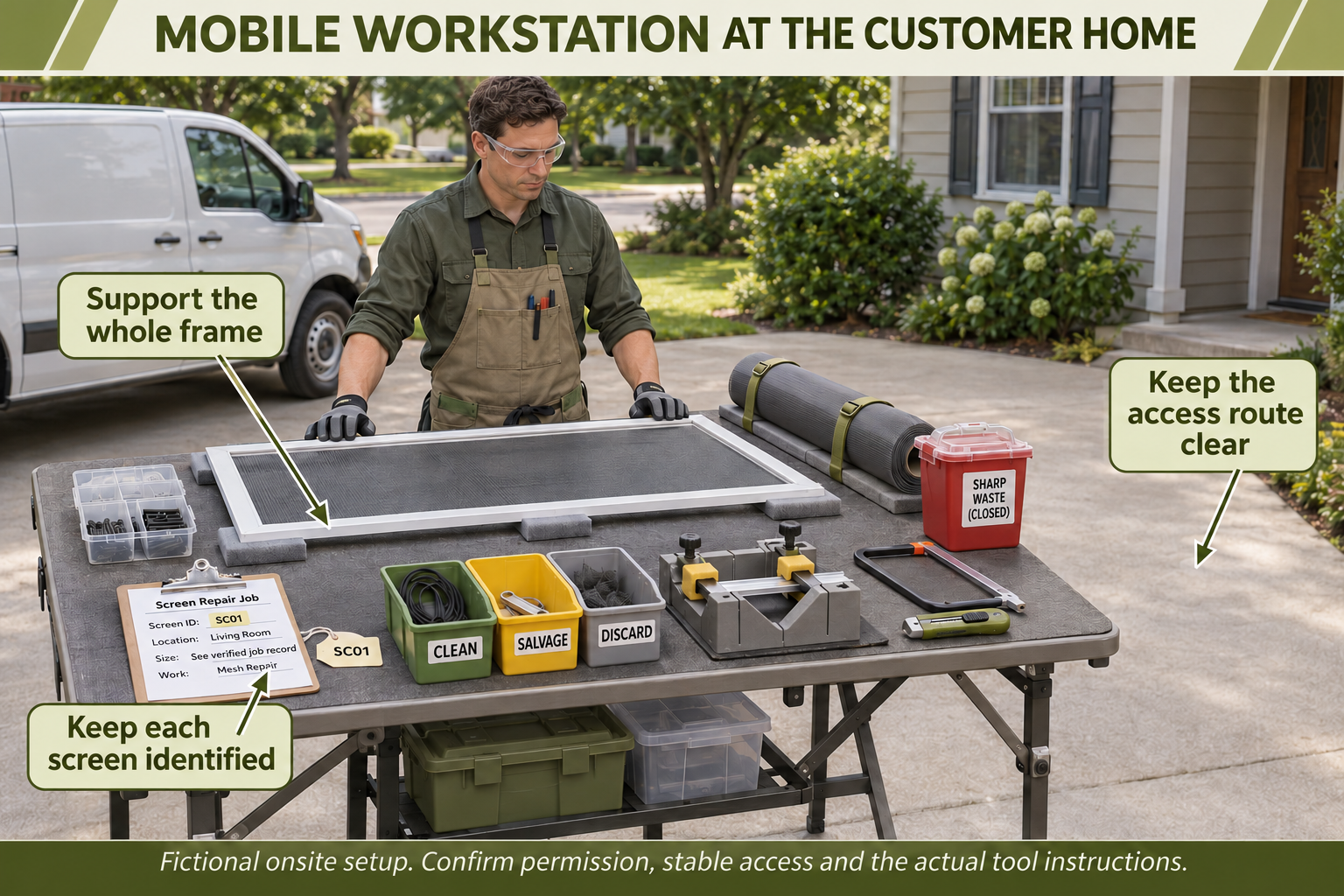
Place the table on a stable surface and protect the customer’s property with the agreed barrier. Confirm that each frame and rail can be supported without crossing a walking route or pressing against glass. Keep the release path from the household to the bench clear. Arrange incoming frames in protected individual positions so rigid corners cannot cut adjacent mesh. Do not stack heavy toolboxes on frames or lean a collection of unsupported screens where one can slide into another.
Set a clean stock area away from chips and used mesh. Keep sharp waste contained and stage the saw, roller and closed knife where their handles are reachable without crossing a blade. Clamps and supports should hold rigid parts securely without crushing a hollow rail. Rehearse one normal tool movement with the blade closed or the tool safely inactive, then confirm that the support and your stance remain stable. Correct the setup if it moves; a hand is not a substitute for a vise.
Open the full-size illustration ↗
Illustration sources: ST09, ST14, ST15, ST16.
Remove by the identified method and tag immediately
Before releasing a retaining device, support the frame at suitable rigid points and follow the documented product sequence. Operate the identified retainers while keeping the assembly controlled, then carry the screen along the approved route. Do not pull on mesh, pry against the glass or assume that a tab releases every type of screen. If a retainer is stuck or the frame needs force, stop the removal and return to the survey decision.
Attach or confirm the matching tag at once. For the two damaged assemblies, preserve the accepted corner references and photos before separating any useful measuring evidence. Set their rejected parts apart from reusable frames. Record a discovered defect against the original opening ID rather than inventing another screen number. The window opening remains an access and household safety matter while its screen is absent. Restore it according to the agreed safe arrangement when work is deferred; do not leave an unsecured opening and drive away.
Prepare for a tool incident without improvising treatment
Complete the S17 incident-action card before cutting. Record the actual site address, reliable phone access, emergency entrance, customer contact and location of first-aid supplies. Know how to obtain appropriate medical help. If someone is injured or a sharp fragment is released, stop the task, make the tool safe if you can do so without further exposure, and keep others out of the affected area. Use trained first aid and medical or dispatcher guidance; this course does not teach wound treatment or eye-fragment removal.
Call 911 for a serious or time-critical emergency and give the location, nature of the injury and access information. For another injury or uncertainty, obtain appropriate medical advice rather than treating continued work as the default. Do not search an eye with tools, resume with a damaged blade or ask the customer to hold an unsafe rail. Preserve the incident facts and isolate the equipment for review. The card’s purpose is to make practical actions and contact information available before anyone is distressed.
Release one controlled production sequence
Check S17 once more: tools inspected, eye and hand protection appropriate to the task, stock supported, cutting path clear, sharp container available and household separated. Then compare your screen tags with S07 and S18. Work one assembly through its condition gate rather than removing all identities and trying to sort the parts afterward. If you batch similar cuts, keep every part linked to its destination and cut sheet.
The exercise is a setup rehearsal, not a call to emergency services or a practice injury. Choose a tabletop location and identify one deliberate defect, such as a clamp that lets a rail slide. Correct it and record the change before any real cut. A workstation is ready when the physical setup, household arrangements and response card are usable together. A checked box without the corresponding table support or phone information is an unfinished preparation task.
Put it into practice
Your assignment
Rehearse a Case S setup and respond to a simulated loose saw blade.
Inputs
- Stable accessible property; six tagged openings.
- A blade becomes loose before the first rail cut.
- This is a tabletop drill; no emergency call is made.
Your deliverable
S17 setup record and six-step incident/control rehearsal.
Saved only in this browser when storage is available. Export this page separately and use fictional identifiers in practice.
Show the worked answer
- Stop cutting and put the saw in a safe isolated position; keep household members outside the work area.
- Do not resume until the tool is repaired or replaced according to its instructions and the setup is checked.
- Confirm address, access, phone and first-aid location; serious actual injury would require emergency help, with assistance limited to training and guidance.
Show the self-check criteria
- No cutting with a loose blade or hand-held unsupported stock.
- No invented medical treatment or actual practice emergency call.
- Screen IDs and household/window arrangements remain controlled.