Leave the customer’s property controlled and clean, reconcile real stock movement, and preserve a complete visit record for the next operating decision.
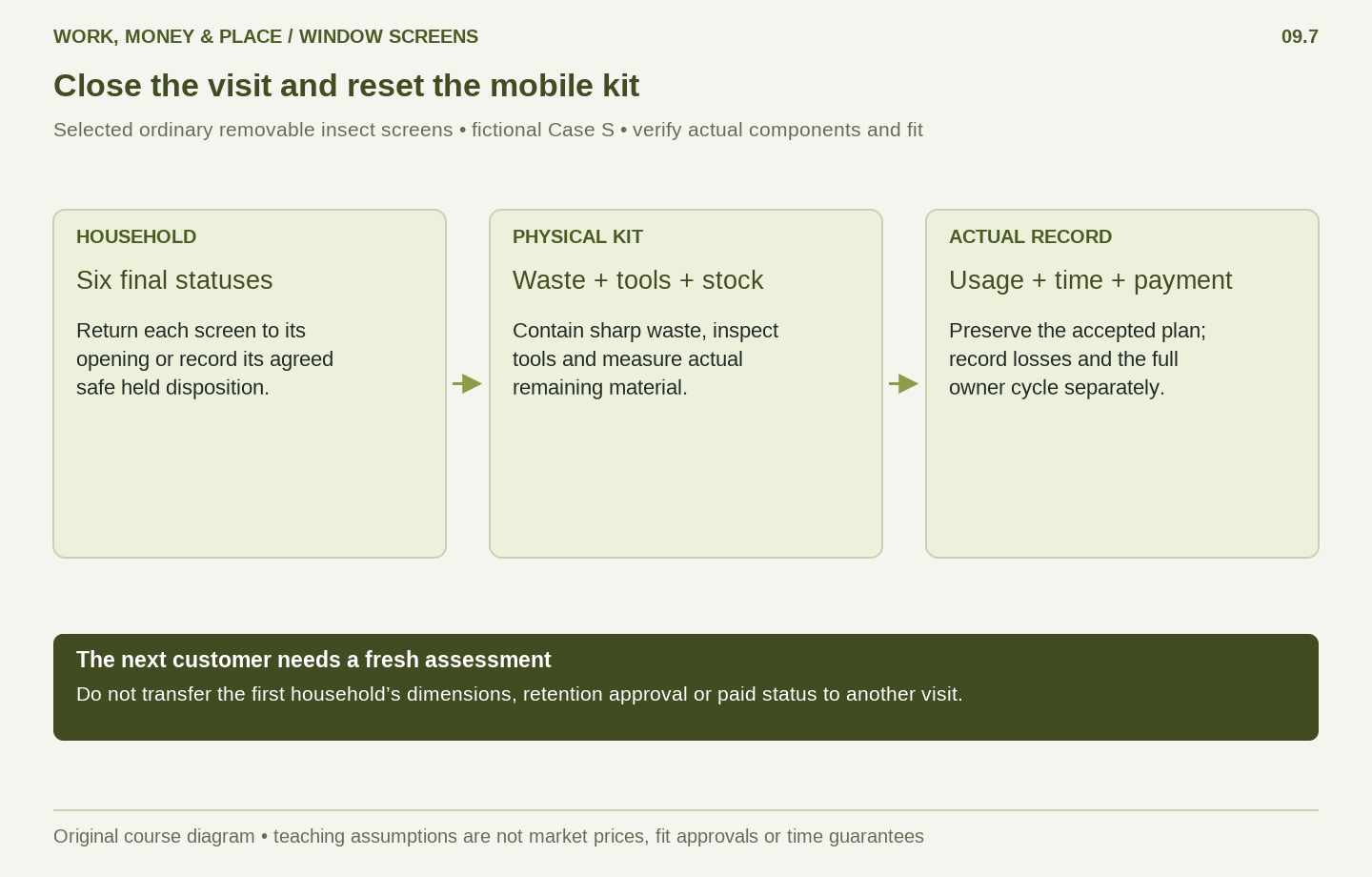
Open the full-size diagram ↗
Example and worksheet
Connect this lesson to the complete Case S records. Keep the fictional example separate from your own project.
Close each opening record before packing the bench
Review S19 against the original six-screen inventory while access is still available. Confirm that each completed assembly is in its own opening and that any held item has an agreed safe disposition. Recount removed and returned screens; an unreturned customer frame must not disappear into van stock. Note the final condition, correction and customer handoff. Do not pack all measuring tools first and discover afterward that a question about fit still needs to be resolved.
Make a final household check with the customer. Confirm that the agreed windows, doors, paths and pet arrangements have been restored appropriately and that your work has not left tools or sharp waste behind. This does not certify the building or replace its owner’s responsibilities. It closes the temporary conditions your visit introduced. Preserve the original warning labels and report an unresolved safety or opening issue instead of covering it with a business label.
Contain waste and protect the property
Close cutting tools and collect mesh strips, spline ends, rejected corners, metal offcuts and chips in appropriate containers. Separate sharp pieces so they cannot puncture an ordinary bag or injure someone handling it later. Inspect the table cover, ground and route under adequate light, including places where a cut offcut could have dropped. Do not brush sharp fragments into a lawn with bare hands or leave old mesh folded where a child or pet can reach it.
Remove protective materials without spreading their debris onto the customer’s surfaces. Keep ordinary loose-debris cleanup distinct from chemical cleaning, paint disturbance or hazardous-material removal, which are outside this starter visit. Check local disposal or recycling acceptance before promising that all mixed mesh, spline and frame waste will be recycled. A material that looks metallic can contain coatings or mixed components, and a container’s contents should match the actual receiving facility’s rules.
Reconcile purchase, issue, installation and loss
Use S09 and the stock ledger to record what actually happened. The planned six-screen material issue includes two whole kits, 242 linear inches of mesh, separate replacement spline for four rescreens and protective supply. The whole kit price already includes its supplied components and normal cutting remnants. Do not recover a fictional second profit by pricing the unused optional springs as though you purchased them separately for this job. Record retained kit spares physically without allocating the whole purchase twice.
For separate spline, distinguish the stock-issue allowance from the actual measured groove route, installed cord, usable offcut and discarded loss. Mesh side strips are measured remnants, not full-width roll length. In the actual-variance exercise, an extra forty-inch mesh issue and 126-inch replacement-spline issue are losses from a remade panel. Record them once, in addition to the original plan, and state what failed. Do not call material still on the shelf a job expense merely because you bought it before this visit.
Reset the mobile kit and protect remaining stock
Inspect tools for wear or damage after the work, not just at the start of the next customer’s appointment. Remove loose debris by the tool-compatible method, dry and protect tools as appropriate, and store blades covered or retracted. Isolate a damaged roller or suspect knife so it cannot accidentally return to the ready tray. Keep labeled mesh, cord and matching components protected from moisture, pressure and sharp items. An unknown loose part remains HOLD even when it resembles something you used successfully today.
Support customer frames that must be transported or temporarily stored so they cannot bend or carry pressure from other cargo. The cited manufacturer storage guidance is about supporting and protecting screens; it is not a complete vehicle load-securement specification. Follow the vehicle and storage system’s instructions and applicable requirements for transport. Do not place a screen loose against a windshield or use mesh as a tie-down point. Replenish actual consumed stock before offering another same-visit appointment.
Preserve the accepted plan and compare the real cycle
Close S13 with actual time for the entire owner cycle and link it to the preserved accepted estimate. The case planned three and a half hours, but its separate actual exercise records four and a half. Keep both versions rather than editing the plan until it matches reality. Record the cause of extra time and loss: a remade panel, an unexpected but supported correction or slower practice technique may imply different next actions. Do not present the fictional case as a promised production rate.
Finish payment and receipt records through the agreed business process, keeping customer tax reserves and payment fees separate from spendable money. Save product evidence, permission-limited photos, inspection decisions and changes in an organized protected location. The next customer is a separate assessment, not a repeat of this household’s dimensions or retention approval. A clean closeout gives the owner a useful answer to three questions: what was completed, what it actually consumed, and what must improve before the next visit.
Put it into practice
Your assignment
Close the six-screen visit with one remade-panel loss and a separate next-customer request.
Inputs
- Plan: 242 in mesh and 504 in separate replacement spline.
- Actual exercise adds 40 in mesh and 126 in spline loss; full owner time 4.5 h rather than 3.5 h.
- A new customer requests two 28 x 36 rescreens.
Your deliverable
S09/S13 stock and time closeout, S19 final statuses and a fresh next-customer survey.
Working forms: S09, S13, S17, S19.
Saved only in this browser when storage is available. Export this page separately and use fictional identifiers in practice.
Show the worked answer
- Actual mesh issue 282 in; separate replacement spline issue 630 in, with the extra 40/126 recorded as remade-panel loss, not another completed screen.
- Record 4.5 h actual against 3.5 h preserved plan; do not alter the accepted baseline.
- Next customer needs a separate compatibility/access survey; its 32 x 40 mesh blanks do not inherit the first job’s opening fit approval.
Show the self-check criteria
- No kit-component double counting or full-width credit for narrow side strips.
- Sharp waste, tools, customer frames and household arrangements checked before departure.
- Actual records identify losses and correction; next job remains separately assessed.