Complete an item-level handoff and reconcile the customer invoice, actual receipt fee, tax held and evidence retained.
Open the full-size diagram ↗
Example and worksheet
Connect this lesson to the complete Case S records. Keep the fictional example separate from your own project.
- Case S 01 · Assess the six-screen mobile job
- Case S 02 · Write the complete scope and customer offer
- Case S 03 · Price the defined work and separate customer tax
- Case S 08 · Fund purchases and hold collected tax
- Case S 11 · Reconcile actual usage losses and variance
- Case S 12 · Preserve the accepted plan and transfer the method
Download the formula planner ↓
Example tab: First cash. Your blank tab: Your cash.
Study the filled First cash example tab without replacing its Case S data. Enter your own job in the separate blank Your cash, Your actual tabs. Save a separate copy to experiment with a teaching example, and preserve a dated accepted baseline.
Inspect each agreed item with its opening tag
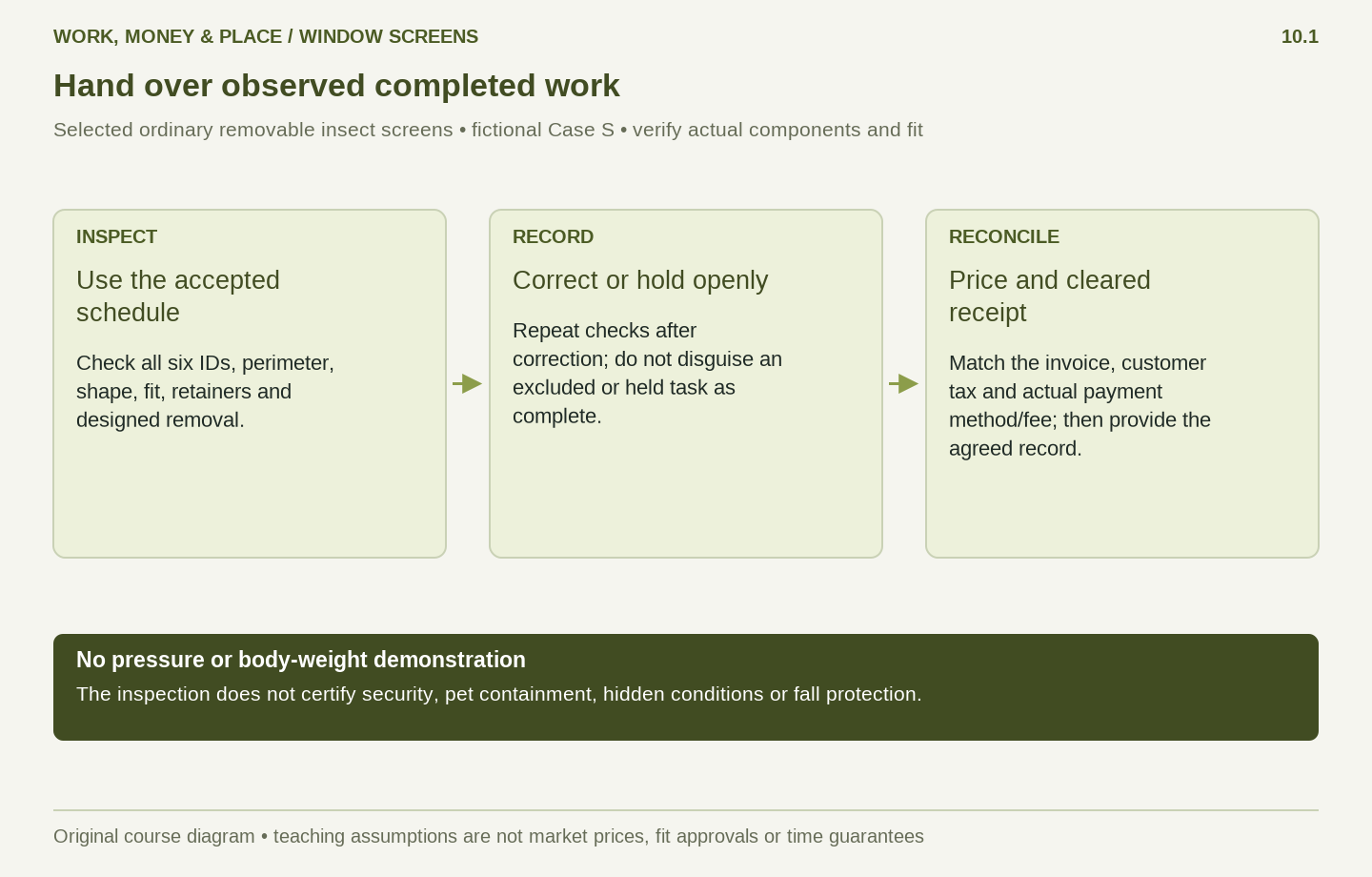
Use the accepted six-item schedule during the walkthrough. SC01 through SC04 are the rescreened original frames; SC05 and SC06 are the new selected-kit frames. Match each tag to its opening, inspect the agreed dimensions, supported mesh tension and trim, frame shape, pull hardware, seating and original retention. Check normal window operation and required access within the assessed service boundary. Do not treat a six-screen count as proof that every individual item was correctly fitted.
A visible result has limits. Record pre-existing marks, an excluded surface or a held component separately rather than calling it repaired. An insect screen is not a security device or child-fall barrier. A customer’s satisfaction or payment cannot approve an unsafe retention arrangement, an incompatible profile or unsupported access. Stop an affected issue and document the next decision instead of inventing an adjustment to make the handoff appear complete.
Resolve a missed included task without inventing new scope
If an included task was missed and the same supported safe method can correct it, make the correction and inspect again before closing that item. If the issue reveals changed dimensions, damaged hardware, a different system or window/building damage, it is a new assessment question. Use the agreed hold/change process and state the scope, charge and completion consequence in writing. Do not force a frame, add adhesive or drill a window to avoid discussing the problem.
The handoff record should distinguish completed, corrected, excluded and held work by item ID. Keep the agreed customer preparation, starting-condition notes and accepted version available for comparison. Record factual observations and the customer’s stated concern without assigning an unsupported cause. A written completion note is useful evidence, but it is not a universal waiver, a manufacturer guarantee or a substitute for locally appropriate service terms and customer rights.
Issue the invoice on the accepted tax basis
With no approved scope change in the base case, the invoice retains four $35 rescreens, two $85 new-frame items and the $50 callout. Service revenue is $360. The fictional 10% customer tax is $36 and the customer total $396. No deposit or separate customer card surcharge is included. The operator’s processor fee is not an extra customer line after the quote was accepted. If a legitimate change was agreed, reconcile it to its separate written version rather than silently changing the original.
The tax rate is an arithmetic assumption, not a current local rate. For a real invoice, use the correct classification, sourcing and rate for the actual repair/fabrication work. Consumer tax, manufacturing questions and other business taxes remain separate matters. Keep the records that support the chosen treatment. A completed screen or a card receipt does not establish which tax rule applies, and tax collected from the customer is not additional service income.
Reconcile the actual payment and cleared bank event
The single modeled $396 card payment has a $10.20 fee, so $385.80 clears into bank. Match gross, actual fee, net received and clearing date to the payment record. A payment due or authorized on Day 0 may clear later. Read First cash for the filled example; record your own actual clearing event in blank Your cash in a saved working copy and S12. Keep the example intact. Do not enter both the net amount as gross and the fee again, which would subtract it twice, or call an unpaid invoice collected revenue in the cash calendar.
Reserve the $36 customer-tax portion of the gross receipt under the stated assumption. The first project bank then ends at $585.80 with $36 held and $549.80 unrestricted, after the original stock/fuel payments. If a customer uses another payment method, record its actual fee explicitly, including verified 0 for cash. A mixed method needs separate rows. Explain discrepancies before marking the financial handoff reconciled; do not hide an unknown fee or missing date behind a zero.
Close the connected record and retain useful evidence
Keep the accepted offer, measurement/tag schedule, component compatibility record, material movements, full-cycle time, inspection/changes, invoice and payment evidence connected by job ID. Separate necessary business records from private access information, and retain them under a policy appropriate to the business. The IRS guidance supports organized transaction records and documents; this course does not provide a complete retention period or tax-method election for every business.
Before departure, account for the tools and the customer’s retained/discarded items, contain sharp offcuts and used materials under the agreed process, and leave safe access. Complete the stock and time records even if the customer paid promptly. A clean bank deposit alone cannot explain whether stock was lost or owner time exceeded plan. The connected file lets the later actual review compare the same completed work with the accepted plan and identify a supported next action.
A later correction or return visit needs its own record even when it creates no additional customer charge. Identify the original item, reported concern, inspection result, agreed action, travel, material use and owner time. Do not invent another sale merely because a second trip occurred, or hide its cost by overwriting the first estimate. If the concern falls outside the accepted work, explain the assessed boundary and use the agreed next decision. Keep records factual and proportionate: retain the needed job evidence without placing private entry codes, unnecessary household photographs or unrelated personal details in shared teaching examples.
Put it into practice
Your assignment
Complete the inspection record and reconcile the invoice in S19; enter the payment in Your cash in a saved working copy. Read First cash only as the filled example.
Inputs
- No scope change was approved: service $360, tax $36, customer total $396 and one card payment. Complete the item-level inspection.
- Processor record: gross $396, actual fee $10.20 and net receipt $385.80. Use its actual clearing date in Your cash; retain the dated accepted estimate and invoice.
Your deliverable
A dated saved working copy using the named blank Your worksheet, the connected forms and a short reconciled explanation. Keep the filled First and Repeat examples intact.
Saved only in this browser when storage is available. Export this page separately and use fictional identifiers in practice.
Show the worked answer
- Invoice service lines remain $140 + $170 + $50 = $360. Tax is $36 and customer total $396.
- Enter gross $396 and actual fee $10.20 on the clearing date; reserve $36 under the stated assumption.
- Record completion and limits for each item. Retain the accepted scope, stock/time evidence, invoice and payment record.
Show the self-check criteria
- No unsafe or held task is described as completed.
- Gross, fee, net and tax reconcile without a second fee deduction.
- All six tags and any correction are traceable.
Sources: SF01, SF02, SF03, SF04, CASE-SC-01.