Review the first operating period using separate acquisition cohorts, matching-scope actual results, cash liabilities and realistic workload sensitivity.
Open the full-size diagram ↗
Example and worksheet
Read the separately labeled fictional Case S records, then complete your own dated assessment. The example is not a supplier quote, legal determination, physical demonstration or beginner production-time guarantee.
- Case S 06 · Read the matching-scope management result
- Case S 08 · Fund purchases and hold collected tax
- Case S 09 · Model a separate next-customer route visit
- Case S 11 · Reconcile actual usage losses and variance
- Case S 12 · Preserve the accepted plan and transfer the method
Download the formula planner ↓
Example tab: First actual. Your blank tab: Your actual.
Open the downloaded workbook and select the named tab. Use the example for reasoning, then enter your own supported inputs in a separate blank Your sheet.
Close the period with definitions and actual evidence
S24 begins with a defined period, actual service area and offer version. Record inquiries, suitable requests, issued quotes, acceptances, completed visits and cleared payments as distinct counts. Identify cancelled or held work rather than silently removing it. A booking made near the end of the period may not have been completed or paid yet. That is a timing fact, not a failed calculation. Reconcile the count to your job and cash records before drawing a marketing conclusion.
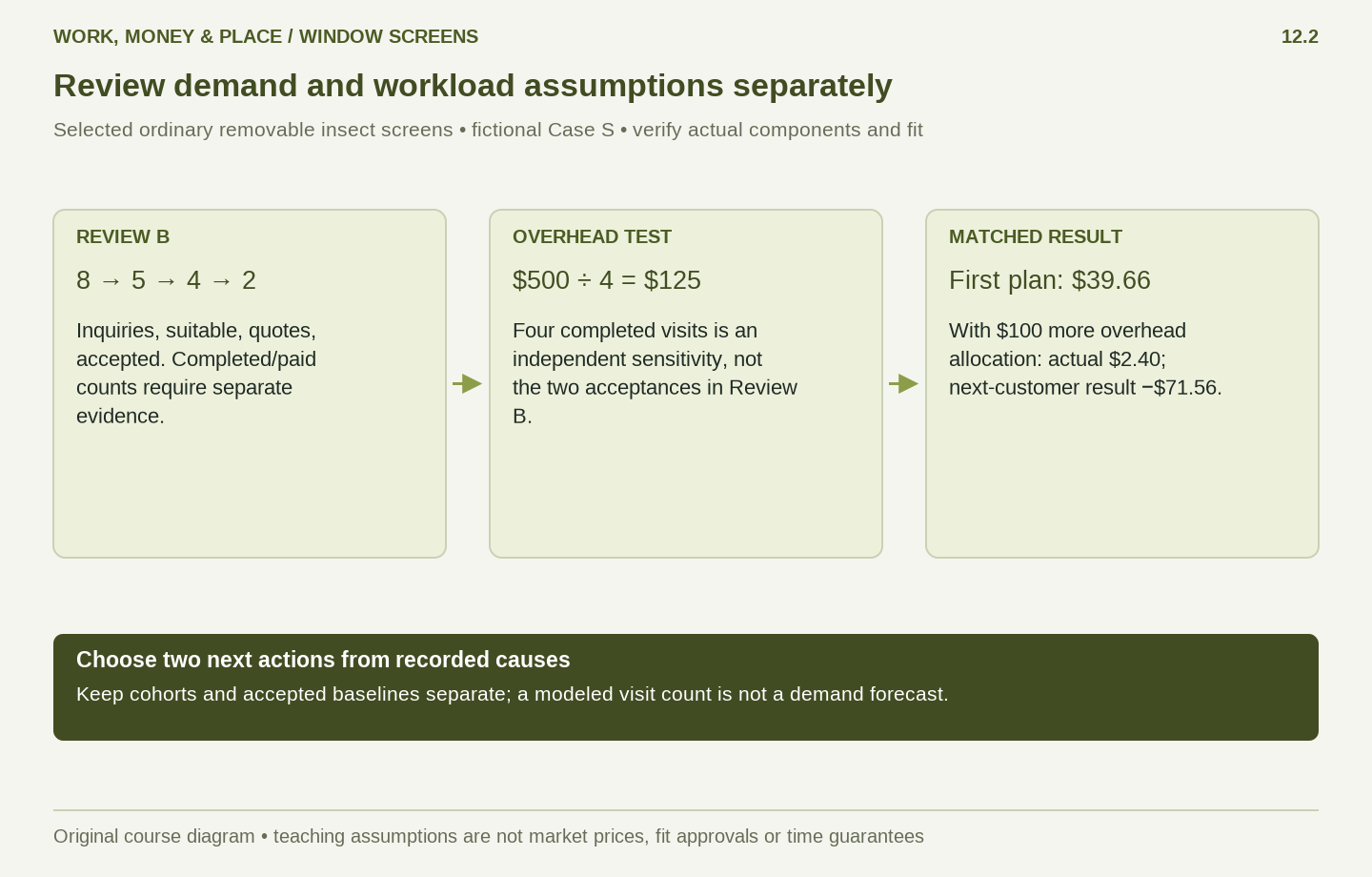
First-Month Review B uses eight inquiries, five suitable requests, four quotes and two acceptances as a separate fictional cohort. Quote acceptance is two out of four, or fifty percent. Those numbers are not Acquisition Test A’s ten/six/four/two and should not replace or merge with it. They also do not establish the completed-visit count used for a separate workload sensitivity. Keep the cohort, period and purpose beside every ratio. Small samples can guide a next test without supporting a claim about predictable annual business volume.
Compare accepted and actual work without moving the baseline
Use S13 to compare the same accepted scope on the same basis. Case S’s first accepted plan has a $139.66 management result before allowance and other applicable business taxes. The alternative actual-first path has $59.40 materials, $18 fuel and 4.5 owner hours valued at $30, giving $102.40. The decline is $37.26: $3.26 of job-attributable material loss, $4 fuel and $30 owner labor. Do not change the accepted plan’s time or stock to make the variance disappear.
The losses have a physical cause and a documented disposition. Reusable remaining offcuts are not automatically waste, while discarded material is not ordinary useful installation consumption. Review whether the cause came from measurement, cutting, labeling, tension, travel or another recorded event. Choose a specific improvement that would address it. A lower result is useful evidence when it changes the process. It is less useful when hidden behind the statement that the customer paid the invoice, because payment alone does not establish that the job supported its complete costs.
Test overhead against the workload that actually happens
The base overhead assumption is $500 per month allocated at $25 per completed visit, which implies twenty visits for that allocation. This is a planning basis, not a forecast that a beginner will complete twenty visits. In a separate sensitivity, use four completed visits: $500 divided by four is $125 per visit, or $100 more than the base allocation. Keep this four-visit sensitivity distinct from Review B’s eight-inquiry cohort and its two acceptances; no supplied evidence connects those counts.
Applying that $100 incremental allocation to the first planned job lowers its management result from $139.66 to $39.66 before allowance and other business taxes. The alternative actual-first result becomes $2.40; the separate next-customer result becomes negative $71.56. These are sensitivity comparisons, not additional bank payments of $100 for every model at once. The actual monthly overhead is paid according to its own calendar. The exercise shows why low-volume periods and small visits require attention even when each job has low visible material expense.
Reconcile cash, stock and obligations before taking money out
Close the physical stock record and the bank/tax record separately. The planned first-plus-next sequence leaves $54.18 of stock and a simplified project bank balance of $714.92 with $49 held customer tax, giving $665.92 unrestricted within that model. It is not a report of personal pay or the sum of net profits. Starting money, the chosen expense-payment schedule and remaining inventory explain why different records have different totals. Use actual evidence for your own period and keep alternative scenarios outside the live book.
Customer tax collected must be reconciled with the applicable liability and remittance schedule. Other business taxes and personal obligations need their own appropriate planning; the course result has not deducted every such amount. Check receipt fees, missing dates, unrecorded losses, refunds or corrective visits and any reserve warning before relying on a free-cash number. Do not take funds from held tax to make the month look successful. A modest actual bank balance can be manageable when the commitments are known, while a large unsegregated balance can conceal money already owed.
Choose two operational changes and test them
Choose improvements supported by the period’s evidence. Repeated wrong-opening problems call for a stronger tag and orientation process; unavailable components call for narrower intake or better verified stock; a weak small-visit result calls for travel, minimum-offer or cost investigation. Do not automatically expand the product menu or spend more on promotion before correcting a problem that every new job would repeat. Retain the prior offer and calculation versions so you can tell whether the change helped.
Give each next action an owner, a review date and an observable measure. For example, test whether a pre-dispatch component check reduces held units, while preserving the onsite assessment rather than treating photographs as final approval. Review owner time, corrective returns, acceptable fit and results together. A quicker operation is not progress if it creates defects, and a higher price is not validated until customers accept the defined scope. The first period is a starting evidence set. Use it to build a more dependable business rather than to publish a success claim before the complete records support one.
Put it into practice
Your assignment
Prepare a first-period review with a separate workload sensitivity.
Inputs
- Review B: 8 inquiries, 5 suitable, 4 quotes, 2 accepted; completed/paid counts need their own evidence.
- First accepted result $139.66; alternative actual $102.40; decline $37.26.
- Separate sensitivity: monthly overhead $500 across 4 completed visits instead of base $25 allocation.
Your deliverable
S24 review linked to S13/S14/S21 and two next actions.
Working forms: S13, S14, S21, S24.
Saved only in this browser when storage is available. Export this page separately and use fictional identifiers in practice.
Show the worked answer
- Keep Review B separate from Test A and from the independent four-completed-visit sensitivity.
- Overhead allocation becomes $125, an increase $100; matching results are first plan $39.66, alternative actual $2.40 and next customer−$71.56 before allowance/other taxes. These are comparisons, not three extra cash payments.
- Retain actual loss/fuel/time causes and choose two measurable improvements, such as unit-tag verification and a cost-supported small-visit/travel test.
Show the self-check criteria
- Accepted baseline and actual evidence remain unchanged.
- Workload assumptions, cohorts and cash movements are not conflated.
- Next actions address a recorded cause and preserve fit/quality boundaries.