Complete a connected launch file that demonstrates a lawful, technically supported, financeable onsite service before accepting a real job.
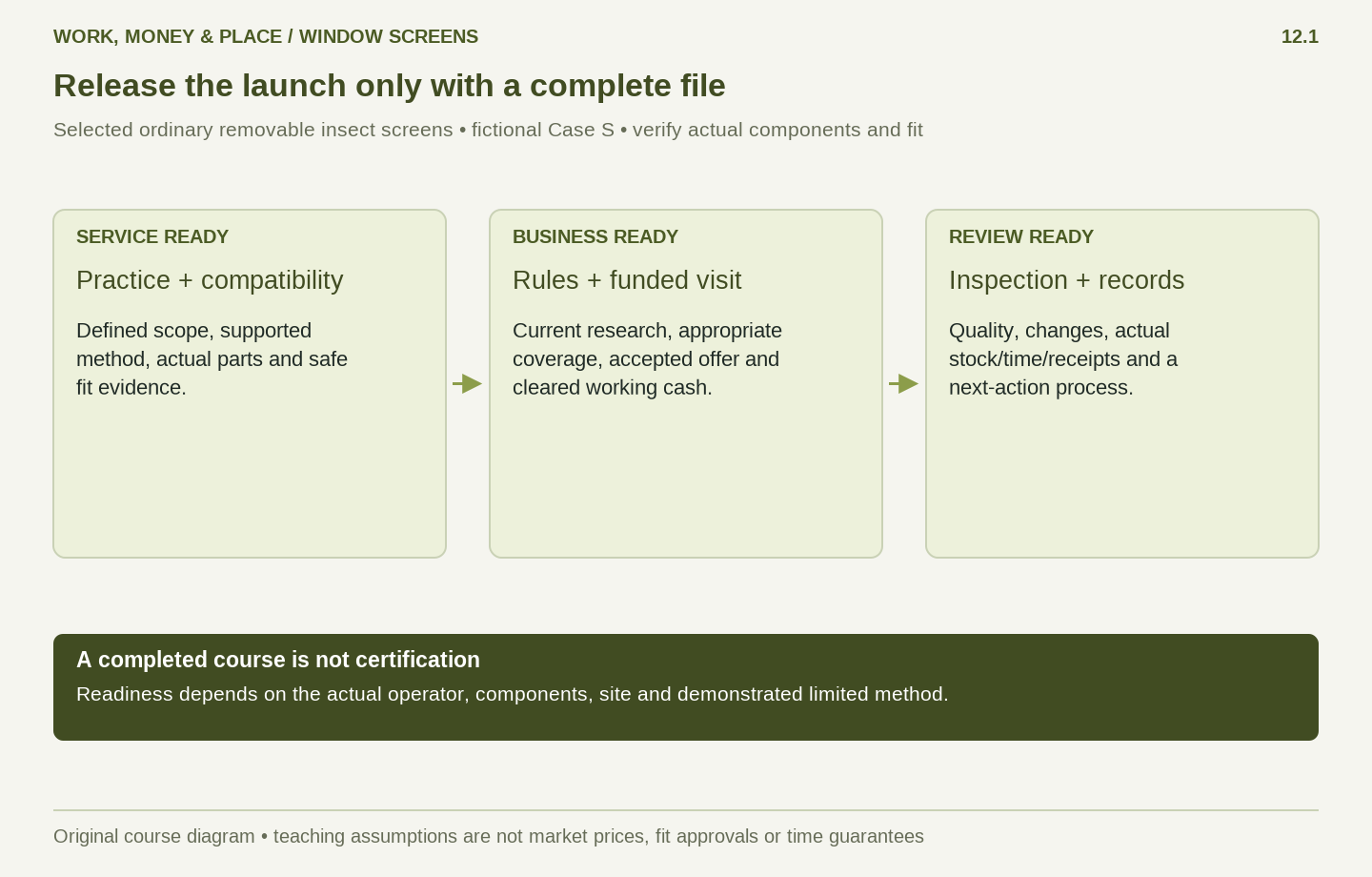
Open the full-size diagram ↗
Example and worksheet
Read the separately labeled fictional Case S records, then complete your own dated assessment. The example is not a supplier quote, legal determination, physical demonstration or beginner production-time guarantee.
- Case S 01 · Assess the six-screen mobile job
- Case S 02 · Write the complete scope and customer offer
- Case S 03 · Price the defined work and separate customer tax
- Case S 07 · Budget the full owner cycle
- Case S 08 · Fund purchases and hold collected tax
- Case S 10 · Calculate launch funding and a tax-aware coverage price
- Case S 12 · Preserve the accepted plan and transfer the method
Download the formula planner ↓
Example tab: First cash. Your blank tab: Your cash.
Open the downloaded workbook and select the named tab. Use the example for reasoning, then enter your own supported inputs in a separate blank Your sheet.
Review a connected packet instead of isolated checkmarks
S23 is a release decision supported by the work you have prepared throughout the course. Begin with S01’s actual offer, S02’s practice evidence and S03’s full-cycle capacity. Check that they describe the same tasks. If the offer includes making new frames but the practice record only demonstrates rescreening, the packet is not ready. If the calendar assumes a fast workstation operation but excludes loading and trial fit, the capacity does not support the advertised service.
The course is written and illustrated, not a supervised trade assessment. Completing a quiz or reading every page does not prove that you can cut, assemble, rescreen, retain and fit a real unit correctly. Use controlled practice on the actual supported system and record the result and correction. Keep tasks outside demonstrated competence out of the first offer. A smaller, complete launch is more useful than a broad list in which important requirements are marked ready because they seem easy.
Resolve the administrative and customer promises
Check the actual registration, relevant endorsements, activity classification and coverage decisions in S05. Repair, fabrication, transport and building installation facts should be described consistently. A general business application does not resolve every contractor or tax question. Confirm the current requirements for the real jurisdiction and scope, and retain the evidence and date. Do not treat the Case S $200 setup allowance or $500 monthly overhead as proof that your real approvals and coverage can be obtained for those amounts.
Then review S06 through S08 and S15 as a customer journey. Can a household identify the accepted units, tasks, preparation, safe access, component/fit limits, price, tax, payment event and change process? Is same-visit completion properly conditional? Are pickup-return and cancelled-access situations addressed if relevant? Preserve applicable customer rights and use appropriate real terms. An unfinished legal or technical decision is not cured by a customer agreeing to your draft. Record the affected scope as unresolved until the right evidence exists.
Show that stock and money can support the first visit
S09 and S10 should identify the actual kit, compatible components, usable stock and funds needed before a customer payment clears. A new business can have enough money for a roller and still lack the correct corner or frame length for an accepted order. Rehearse the staged stock against the specific takeoff, not just a generic shopping list. Protect long components, secure the mobile load and distinguish customer property from inventory. Verify that the workstation can be used at the agreed property.
The fictional launch calculation is $1,732: reusable kit $700, setup $200, first-month overhead $500, unrestricted buffer $200 and first-job bridge $132. The bridge already contains $118 stock and $14 fuel; do not add them again. Suitable transport is already owned in this example, and household living runway is excluded. Those boundaries are material. Obtain your own prices, approvals, coverage and vehicle solution before relying on the total. Startup funding is not the same as a forecast of how quickly customers will pay it back.
Check the quote, cash and incident decisions together
S11 should include the complete owner cycle, documented material consumption, equipment and overhead assumptions, planned receipts and the appropriate tax decision. Retain an accepted dated copy and use a static comparison baseline for S13. S12 needs opening bank including held tax, a separate opening reserve, dated chronological events and actual per-receipt fees. Resolve warnings and confirm that the collected customer tax cannot be spent as unrestricted cash. The Case S ten-percent arithmetic rate is not a verified rate for your first customer.
Prepare the operational response as carefully as the price. Know when to stop for a cutting hazard, unsafe access, unidentified part, damaged frame, failed trial fit or unexpected household condition. Keep relevant product/tool instructions and the site’s required contact/location information accessible. An incident card is a decision aid, not a universal medical or repair recipe. Define how the household is informed and how an affected unit remains on HOLD. A launch packet should make it easy to pause appropriately instead of rewarding completion at any cost.
Decide ready, narrower scope or postpone with a reason
Complete one controlled rehearsal from intake through packed vehicle, assessment, documented compatible work, trial fit, handoff, payment-record simulation and stock reconciliation. Do not charge a fictional receipt to a real card or call an emergency number as practice. Review missing information, avoidable mistakes and actual time. A next action might be another supported practice build, a narrower area, an insurance clarification or obtaining the correct stock. Assign the action and evidence needed rather than only a target date.
When the packet supports a limited real service, choose a manageable first booking and review it promptly. Keep launch capacity below an untested maximum. The written course is free to use, with no course purchase or scheduled access expiry. It does not include business coaching, case-specific legal/tax advice or supervised installation approval. Mandatory consumer rights remain applicable. Your practical release decision remains based on your evidence and obligations. The right outcome of S23 is a reasoned next step, including postponement when a necessary condition is not yet met.
Put it into practice
Your assignment
Make a launch decision from an incomplete packet.
Inputs
- A supported practice repair exists, but new-frame fit practice and an installation classification answer are pending.
- The plan lists $1,732 launch funding with an owned suitable vehicle assumption.
- The draft quote promises every screen completed immediately.
Your deliverable
S23 readiness decision with responsible actions and evidence.
Working forms: S23.
Saved only in this browser when storage is available. Export this page separately and use fictional identifiers in practice.
Show the worked answer
- Do not release the full offer. Complete supported new-frame practice and the applicable activity determination, or define a properly assessed narrower service.
- Correct same-visit wording to depend on stock, fit, access, competence and conditions.
- Check that $132 bridge already includes $118 stock+$14 fuel; verify real obligations/transport rather than treating the fictional total as a quote.
Show the self-check criteria
- Every ready status points to evidence.
- Unresolved skills, activity requirements and fit promises remain visible.
- Funds, customer rights, records and stop decisions support the same bounded offer.