Plan a complete cash sequence, preserve customer-tax reserves and distinguish bank from unrestricted project funds.
Open the full-size diagram ↗
Example and worksheet
Connect this lesson to the complete Case S records. Keep the fictional example separate from your own project.
- Case S 03 · Price the defined work and separate customer tax
- Case S 08 · Fund purchases and hold collected tax
- Case S 09 · Model a separate next-customer route visit
- Case S 11 · Reconcile actual usage losses and variance
Download the formula planner ↓
Example tab: First cash. Your blank tab: Your cash.
Study the filled First cash, Repeat cash example tabs without replacing its Case S data. Enter your own job in the separate blank Your cash tab. Save a separate copy to experiment with a teaching example, and preserve a dated accepted baseline.
Fund what must be paid before collection
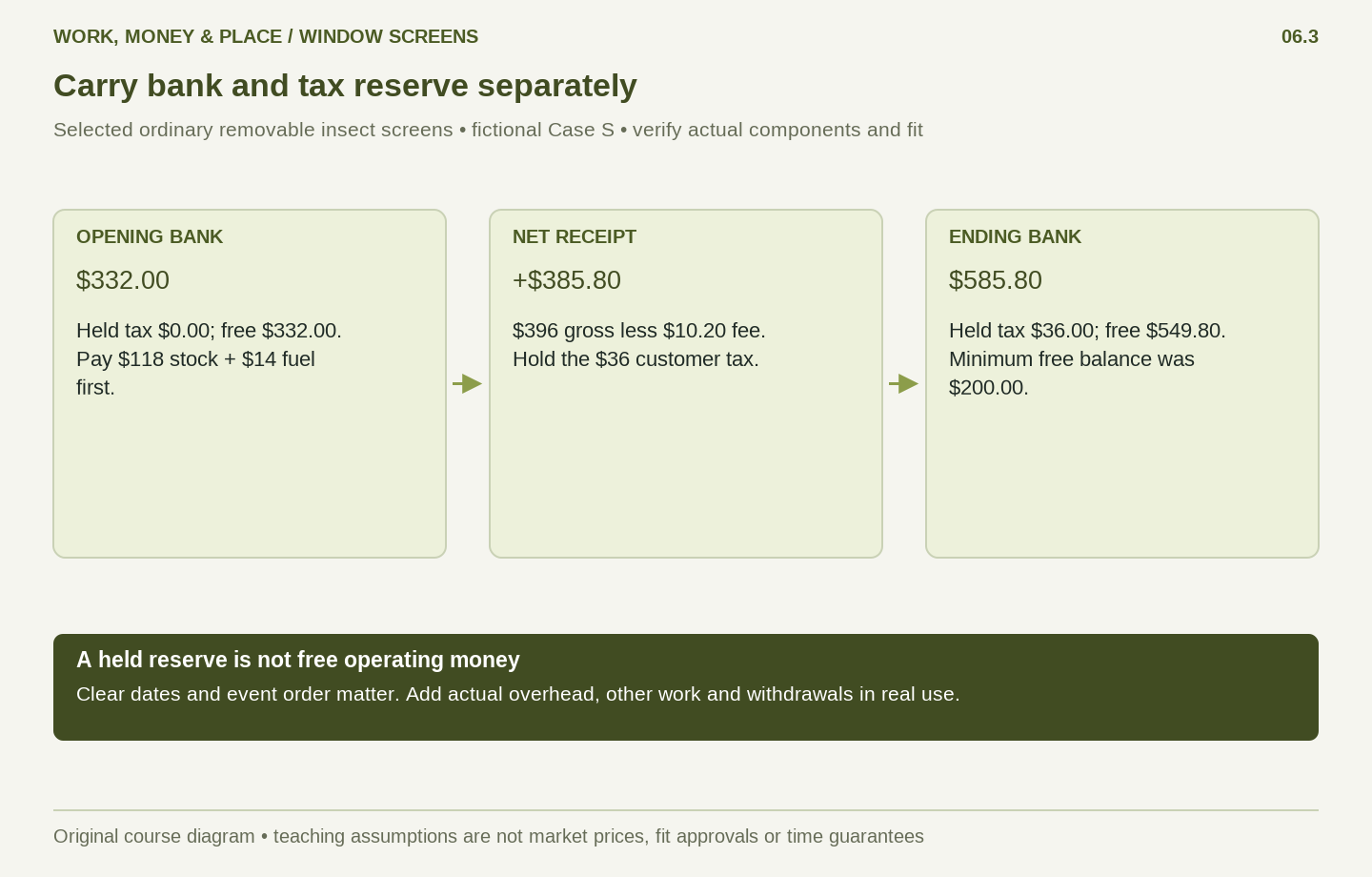
Read First cash as the filled first-visit example. Enter the practice events in blank Your cash in a separate saved copy; do not overwrite First cash. First enter the stated tax assumption in Your estimate, which feeds Your cash. The first visit starts with $332 project bank and a confirmed zero opening tax reserve. That bank contains one $200 unrestricted cushion and a $132 bridge. Buy the $118 stock lot before service and bank falls to $214. Pay $14 fuel and it reaches $200. The bridge is based on actual planned payments, not the $80.34 consumed direct cost or the $210.14 management cost before processing. The unspent buffer is a balance target, not another expense.
Customer payment due after inspection is not necessarily cash already cleared. If the receipt moves from Day 0 to Day 3 and no other outflow intervenes, the same $132 bridge lasts longer but does not grow automatically. If another trip, supplier bill, withdrawal or overhead payment intervenes, enter it on its actual date and retest. A profitable quote can still leave an unfunded gap when the purchase must happen before collection.
Separate the tax inside the receipt
The customer pays $396, the hypothetical processor withholds $10.20 and $385.80 enters bank. After the preceding stock and fuel payments, bank is $585.80. Of that amount, $36 is customer tax held, so unrestricted money is $549.80. Bank includes the reserve; adding the reserve again would invent cash. Customer tax is not service revenue, and a processor fee on the tax-bearing gross does not remove the obligation to account for the collected tax.
In Your cash, F5 is opening bank and F7 is the reserve already held within it. F7 is required: type 0 only after confirming none is held. It cannot exceed bank. F6 links to the tax assumption in Your estimate. The reserve is a management model of the stated receipts, not your complete filed liability. Actual refunds, credits, sales-tax returns and other business taxes need a separately reconciled record.
Enter actual fees and every required row field
Each active row requires a date or relative day, a useful event label, gross receipt, actual processing fee, other cash paid and tax remitted. Use checked zeros when a category does not apply. Keep rows consecutive and chronological. The workbook calculates in entered row order; changing the date does not sort the events. A fee-only orphan row or a missing earlier date must block reassuring ending balances rather than disappear inside a sum.
Mixed methods need separate fees. In a separate saved Your cash exercise with opening bank 0, a $100 card receipt with $2.80 fee and a $100 cash receipt with confirmed $0 fee increase bank by $197.20 before other outflows. If each gross includes the fictional 10% tax assumption, the row-rounded reserve is $9.09+$9.09=$18.18 and free cash is $179.02. Do not charge the cash receipt another card fee or describe the whole $197.20 as free of tax.
Carry both balances and recognize excess remittance
Inspect Repeat cash for the filled separate-next-customer example. For your own next job, start another saved Your cash copy and transfer your preceding record’s ending bank and reserve separately. Repeat cash remains the name of the worked example. It carries First cash ending bank $585.80 and tax reserve $36 into distinct opening fields. After $10 fuel and the $143 gross receipt less $3.88 fee, bank reaches $714.92. The new receipt reserves $13, so total held tax is $49 and free cash is $665.92. This is not a promise of repeated repairs from the same household.
If a subsequent row remits the full $49, bank and reserve both decline by $49 while free cash remains $665.92. Remitting $50 instead uses another $1 of free cash. The modeled reserve stops at 0 and flags that excess permanently in the running history. A later receipt can create a new reserve, but it must not erase the earlier warning or imply a credit. Reconcile the flagged remittance with actual tax records before deciding what it means.
Read the funding decision and its limits
The first plan requires $332 unrestricted starting funds to preserve the $200 cushion through its $132 pre-receipt payments. With $332 available, additional funding is 0. The alternative actual pays $18 rather than $14 fuel: minimum free cash becomes $196 and another $4 is needed to preserve the same target. Its extra stock losses fit inside the original purchase, so there is no invented second supplier payment. Loss still reduces stock and the management result.
Use S12 to explain every balance in plain language: cash received, bank, tax held, free cash and required starting money. Add real company obligations and owner withdrawals before using the model to make spending decisions. Dates, amounts and explicit reserves must be complete even when a later receipt appears large enough to cover a gap. Formula protection helps avoid accidental edits; it is not account security, a bank connection or a substitute for financial records.
Check an opening balance that already contains tax. In a separate exercise, bank is $120, of which $20 is held tax; the chosen free-cash cushion is $10 and an ordinary $20 payment comes before any receipt. Free opening cash is $100. After payment, bank is $100, reserve $20 and free cash $80. The minimum unrestricted starting need is $30, so the available $100 requires no additional funding. Its equivalent minimum opening bank would be $50 because $20 is already restricted. This example explains why the funding comparison uses bank minus reserve, not the bank number by itself.
Put it into practice
Your assignment
Inspect First cash and Repeat cash, then build each cleared-cash sequence in separate saved copies of blank Your cash. Keep the examples intact.
Inputs
- First set the fictional 10% assumption in Your estimate. In Your cash enter opening bank $332, reserve $0, cushion $200; date and enter $118 stock paid, $14 fuel paid, then $396 gross collected with fee $10.20. Enter explicit 0 for other checked categories.
- In another Your cash copy carry bank $585.80 and reserve $36 separately; enter next-customer fuel $10, gross $143 and fee $3.88. Date every event. Remit $49 afterward, then test $50 in an experiment copy.
Your deliverable
A dated saved working copy using the named blank Your worksheet, the connected forms and a short reconciled explanation. Keep the filled First and Repeat examples intact.
Working forms: S12.
Saved only in this browser when storage is available. Export this page separately and use fictional identifiers in practice.
Show the worked answer
- First ending bank is $585.80, tax held $36 and free cash $549.80. Required unrestricted opening funds are $332.
- Next ending bank is $714.92, held tax $49 and free cash $665.92. Remitting $49 leaves bank $665.92, held tax $0 and free cash $665.92.
- Remitting $50 instead uses $1 of additional free cash. The excess remains flagged even after a later receipt creates a new tax reserve.
Show the self-check criteria
- Opening bank and reserve are separate and complete.
- Date/relative-day, event and four amounts are entered for each active row.
- Mixed fees and carried reserves reconcile without a negative reserve.
Sources: SF01, SF02, SF03, SF04, CASE-SC-01.