Preserve a static accepted plan, explain the actual variance and revise future work from component and time evidence.
Open the full-size diagram ↗
Example and worksheet
Connect this lesson to the complete Case S records. Keep the fictional example separate from your own project.
- Case S 04 · Stage the kit and reconcile component stock
- Case S 06 · Read the matching-scope management result
- Case S 07 · Budget the full owner cycle
- Case S 08 · Fund purchases and hold collected tax
- Case S 09 · Model a separate next-customer route visit
- Case S 11 · Reconcile actual usage losses and variance
- Case S 12 · Preserve the accepted plan and transfer the method
Download the formula planner ↓
Example tab: First actual. Your blank tab: Your actual.
Study the filled First actual example tab without replacing its Case S data. Enter your own job in the separate blank Your actual, Your cash tabs. Save a separate copy to experiment with a teaching example, and preserve a dated accepted baseline.
Freeze the accepted baseline instead of rewriting it
Inspect First actual for the completed comparison; leave that example intact and use blank Your actual for your own job. An actual review starts from the plan the customer accepted, not the latest version of a working quote. Save the original estimate and scope with a date. In Your actual, identify the accepted date and file/version, then paste the underlying plan amounts as values from your dated accepted Your estimate copy into the Plan inputs. Do not link them to a quote you may revise. Otherwise changing the next price could also rewrite the historical comparison and erase the lesson you are trying to learn.
Confirm matching scope and units before comparing. The base first job has the same six SC01–SC06 items, measured outer dimensions, supported system and customer price in both columns. Approved changes belong in their own record and matching-scope comparison. A different next-customer visit or a helper trial is not the actual first job. Keep those examples separate even though they use the same mobile tools and cost framework.
Reconcile normal issue and every loss
The accepted first normal material issue is $56.14 with planned loss 0. In the actual alternative, normal issue is unchanged. An additional 40-inch full-width mesh blank is lost at $0.05 per inch, or $2. A separate 126-inch bulk spline piece is discarded at $0.01 per inch, or $1.26. Both losses belong to this job. Material cost becomes $59.40 and remaining stock $58.60 from the original $118 purchase. There is no additional supplier payment in this modeled alternative.
Do not add normal side strips, planned kit rail offcuts or kit-supplied components again. They are already in issued material. All loss reduces inventory, while only the supported job portion belongs in this job cost; another company loss must remain outside this customer’s comparison. The physical record must identify the actual lost item and reason, not only type a difference needed to reach a preferred result. Keep any retained remnant’s allocated value consistent with the original costing method.
Explain the result on the same basis
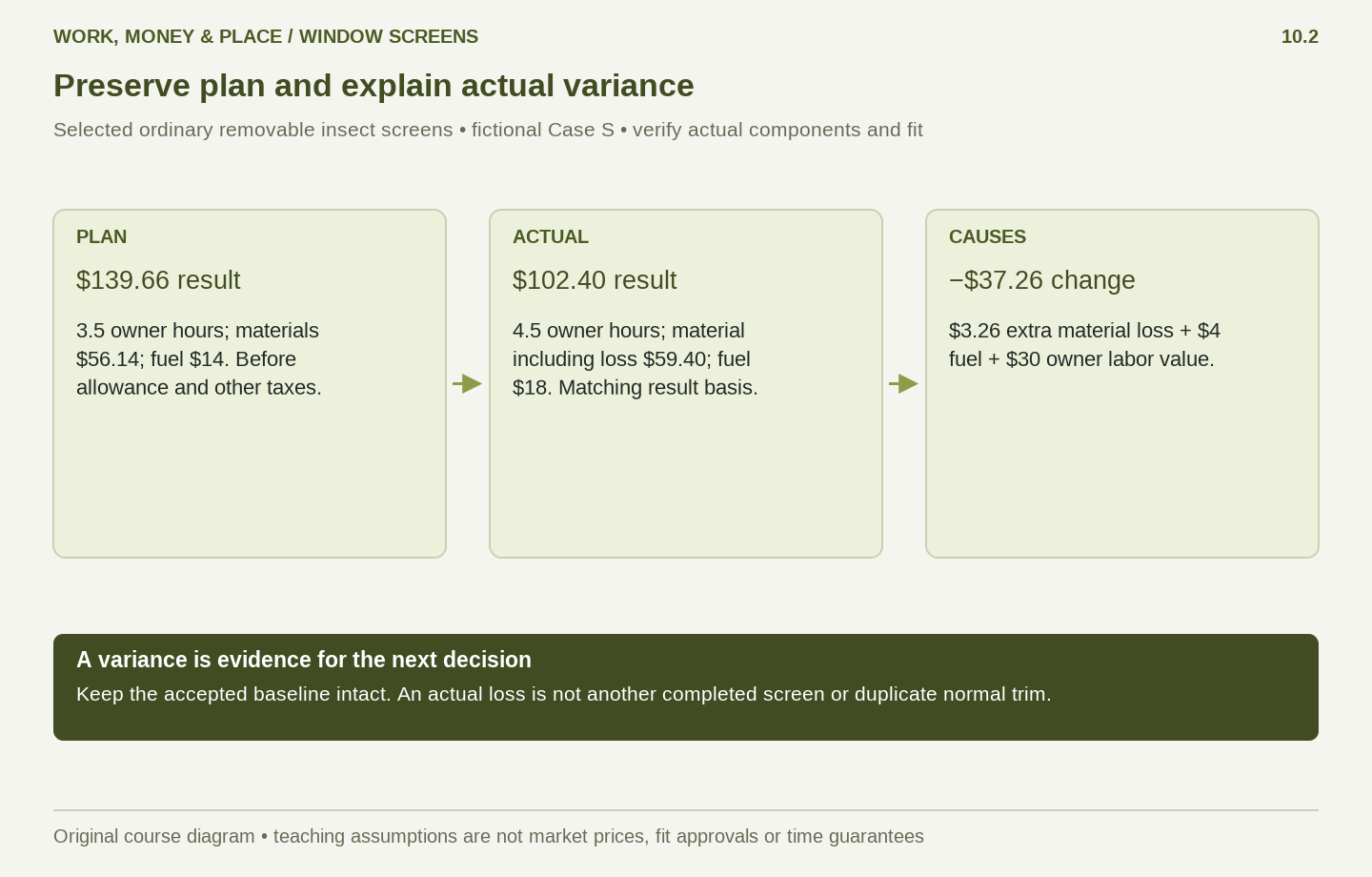
Plan direct cost is $80.34. Actual materials $59.40, fuel $18 and processing $10.20 total $87.60. Owner time rises from 3.5 hours valued at $105 to 4.5 hours valued at $135. Equipment $10 and overhead $25 are unchanged. At the same $360 service revenue, actual result is $102.40 before other business taxes. Compare it with the accepted $139.66 before-allowance plan to obtain $37.26 unfavorable. The bridge is $3.26 material loss+$4 fuel+$30 owner value.
A different comparison uses the allowance-adjusted $119.66 target and gives $17.26 unfavorable. Label which question is being answered; do not subtract an unspent $20 allowance as another actual bill. The actual-review sheet separately shows result, direct cost, owner value and variance explanation. Check that the explanation difference is 0.00. A negative variance is information about this measured work, not proof that the customer should be invoiced extra after the fact.
Explain why cash changed by a different amount
Actual fuel is $4 above plan, so the first cash path ends at $581.80 instead of $585.80. Held tax remains $36 and free cash $545.80. The $3.26 loss uses stock already bought, and the additional owner value is not a second bank payment in this owner-only example. Minimum free cash is $196, so another $4 opening unrestricted money would preserve the chosen $200 cushion. These records answer a funding question, not the same question as the $37.26 management variance.
Reconcile the actual bridge: bank increased $249.80. Remove the $36 held tax and add $58.60 remaining stock to reach $272.40 contribution before owner value, equipment and overhead. Subtract $135, $10 and $25 to obtain $102.40. This check prevents a stock purchase, an existing-inventory loss or an allocation being counted twice. Real company cash includes other jobs, withdrawals, bills and taxes; add those before using the project balance for spending decisions.
Turn a supported observation into the next decision
Review the phase record: first actual 270 minutes versus 210 planned, with 200 onsite and 70 offsite. Investigate the documented losses, setup, cutting, trial fitting, packing and travel. The record identifies where time changed; it does not prove one cause or establish a new beginner speed target. Choose a concrete next test, such as a better tag/cut verification or workstation setup rehearsal, and measure it on another controlled practice before promising a faster customer visit.
Revise future scope, stock allowances, time or price only from supported evidence. Preserve the accepted first copy and record the new version separately. For the next household, repeat the assessment of actual sizes, compatible components, retention and access; do not assume repairs recur or copy a first-job conclusion blindly. Use S13 and S20 to state what changed, its amount, the evidence, the proposed action and how it will be checked. A clear review closes the job and supplies a traceable starting point for the next decision.
Separate utilization sensitivity from a rewriting of this job. If the same $500 monthly overhead is spread across only four modeled completed visits instead of twenty, its share is $125 rather than $25. Holding the other scenario inputs constant reduces the first planned result by $100 to $39.66, the alternative actual result to $2.40 and the next-customer result to negative $71.56. This is a labeled workload sensitivity, not a demand forecast. Do not charge both the entire $500 monthly bill and a $125 share to each job. Keep the accepted comparison intact, then use the separate sensitivity to test future capacity, marketing spend and minimum-visit pricing.
Put it into practice
Your assignment
Inspect First actual, then use blank Your actual in a saved working copy to compare your dated accepted plan with the alternative actual. Keep the exemplar intact.
Inputs
- Paste values from the saved accepted Your estimate into Your actual: planned result $139.66 before allowance. Enter actual normal issue $56.14 plus $3.26 job loss, fuel $18 and owner hours 4.5.
- Service price $360, fee $10.20, equipment $10 and overhead $25 are unchanged. Test actual cleared events in another Your cash copy; do not change the preserved accepted plan.
Your deliverable
A dated saved working copy using the named blank Your worksheet, the connected forms and a short reconciled explanation. Keep the filled First and Repeat examples intact.
Saved only in this browser when storage is available. Export this page separately and use fictional identifiers in practice.
Show the worked answer
- Actual direct cost is $87.60, owner value $135 and result $102.40. Variance is −$37.26 = −$3.26 − $4 − $30.
- Actual stock is $58.60. Bank $581.80 includes $36 held tax and $545.80 free cash. Another $4 of opening free cash preserves the $200 cushion.
- Bank increase $249.80 − tax $36 + stock $58.60 − owner value $135 − equipment $10 − overhead $25 = $102.40.
Show the self-check criteria
- Plan inputs are static and the accepted copy retained.
- Variance bridge reconciles 0.00 on the same scope/basis.
- Future changes are supported and do not overwrite history.
Sources: SF01, SF02, SF03, SF04, CASE-SC-01.