Build a route from independently assessed jobs and distinguish another customer, a paid follow-up and corrective work without assuming recurring repairs.
Open the full-size diagram ↗
Example and worksheet
Read the separately labeled fictional Case S records, then complete your own dated assessment. The example is not a supplier quote, legal determination, physical demonstration or beginner production-time guarantee.
- Case S 04 · Stage the kit and reconcile component stock
- Case S 06 · Read the matching-scope management result
- Case S 08 · Fund purchases and hold collected tax
- Case S 09 · Model a separate next-customer route visit
- Case S 12 · Preserve the accepted plan and transfer the method
Download the formula planner ↓
Example tab: Repeat plan. Your blank tab: Your estimate.
Open the downloaded workbook and select the named tab. Use the example for reasoning, then enter your own supported inputs in a separate blank Your sheet.
Build another assessed job rather than a subscription story
A repaired insect screen does not automatically create a weekly or monthly repair visit. A household may later have another damaged unit, a different property or someone to refer, but that work is not recurring revenue until it exists and is assessed. Build future revenue from assessed requests rather than an assumed subscription for recurring repairs. Use S21 to record a specific next request, its actual units and the conditions that determine whether the same supported method can be offered.
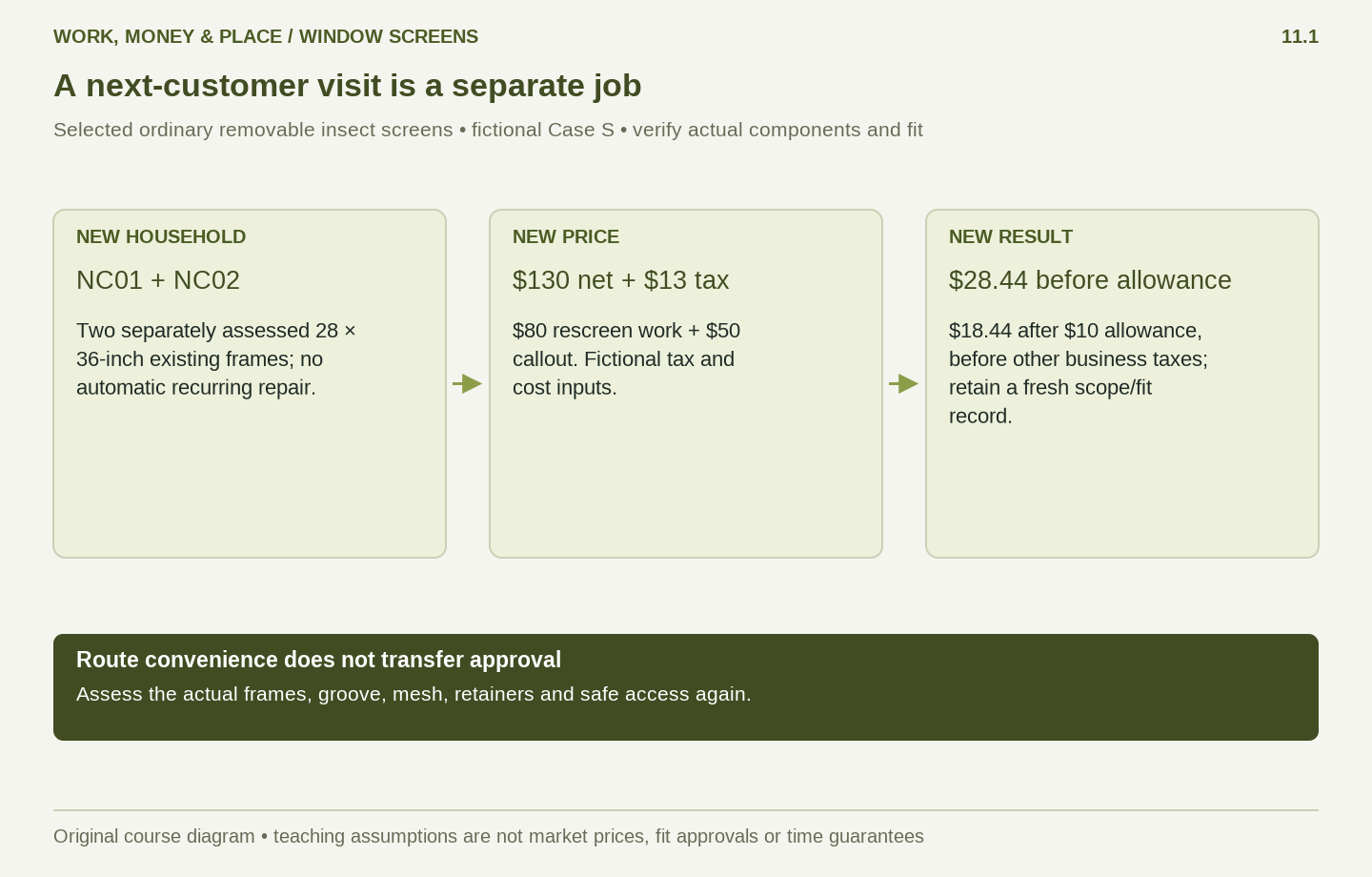
The next-customer Case S example is a different household with two accepted 28 by 36 inch rescreens. It is not a discounted repeat of the six-screen first order and not evidence that the first customer bought more work. The next job has its own opening identities, condition checks, offer, tax and receipt. Some stock and operating preparation can carry forward, but the customer assessment cannot. Keep those distinctions explicit when you build a route or discuss potential future business.
Share a route only where the real work allows it
Two nearby jobs can reduce a portion of travel, but a map is not a schedule. Confirm actual parking, work-area permission, household access and realistic arrival windows. Include loading changes, stock requirements and the sequence of jobs. A new frame needing unfamiliar hardware can disrupt a route even if it is close to the prior address. Do not promise an exact arrival based on ideal fabrication speed or let a delayed first job pressure you into unsafe access at the second.
Use S03 to compare the full owner cycle of each proposed visit and the combined day. Show any shared time explicitly rather than cutting every category by an arbitrary percentage. You still need a distinct unit inventory, accepted offer, fitting and handoff for each household. Carry enough verified compatible stock for the committed work and maintain a realistic contingency. If stock was damaged or consumed on the first job, update the route before setting off rather than assuming a purchase will somehow appear between appointments.
Read the smaller next job on its own economics
The next fictional offer charges two rescreens at $40 plus one $50 callout, giving $130 net. The separate ten-percent arithmetic tax is $13 and gross customer payment $143. A modeled single card fee is $3.88. Material consumption is $7.68, fuel $10, owner labor 1.5 hours valued at $30 is $45, equipment share $10 and overhead $25. The matching management result is $28.44 before its separate $10 planning allowance and other applicable business taxes, or $18.44 after that allowance.
These chosen prices are not market quotes, a rule that a small order always costs forty dollars per unit or a guaranteed margin. The example shows how a smaller visit can have little room after the complete cycle even when the material cost looks low. The $50 callout is part of revenue supporting the visit, not fifty dollars of automatic profit. Assess actual route savings before reducing it. A price that works for a six-unit package does not prove that the same unit rate can support an isolated repair.
Carry stock and tax balances without calling them earnings
The accepted first plan consumes $56.14 from a $118 stock purchase, leaving $61.86. The next plan consumes $7.68, leaving $54.18 if there are no other purchases, uses or losses. Keep these planned movements distinct from the alternative actual-first path, which has its own losses and closing stock. Saleable remaining stock is a business resource, not a cleared customer payment. Carry its physical quantity and documented cost together, and recheck compatibility before committing it to the next job.
The cash example also carries bank and held customer tax separately. After the first planned visit the bank is $585.80 with $36 held; after the next it is $714.92 with $49 held, leaving $665.92 unrestricted in that simplified project cash model. Those balances are not the sum of management profits or personal pay. They include starting money and a particular schedule of paid items. Keep the separate opening fields and use actual receipt/remittance evidence before relying on free cash for a new purchase.
Separate referrals and corrections from chargeable new scope
A referral can be encouraged by letting a satisfied customer voluntarily share a truthful public page. Do not take a neighbor’s private information without permission, exchange fake reviews or promise that every referred household receives the same price. The referred person needs the same scope, access and compatibility assessment. Record the source with appropriate uncertainty, then evaluate the actual accepted job and acquisition effort. A stream of friendly recommendations is useful evidence only when it produces work you can deliver and collect fairly.
A return to correct your workmanship or an identification error is a different event from a new paid visit. Preserve the original job link and appropriate remedy terms. Do not relabel an avoidable correction as new recurring revenue or charge an unagreed callout. A genuine additional request can receive a separate offer after assessment. S21 should state which situation applies, the planned units and time, any stock carried and the accepted payment conditions. That makes the next route a manageable set of real commitments instead of a growth assumption.
Put it into practice
Your assignment
Build a separate next-customer route record.
Inputs
- Next household: two accepted 28×36 rescreens, $40 each plus $50 callout; fictional 10% tax.
- Next owner cycle 1.5 h; materials $7.68, fuel $10, equipment $10, overhead $25, fee $3.88.
- First planned stock remaining $61.86; no additional purchase/loss is assumed.
Your deliverable
S21 separate agreement and S03 route/capacity budget.
Saved only in this browser when storage is available. Export this page separately and use fictional identifiers in practice.
Show the worked answer
- Net $130, tax $13 and gross $143; owner labor $45; result $28.44 before allowance/other business taxes and $18.44 after $10 allowance.
- Carry $61.86 stock to $54.18 after next use; reassess its actual compatibility and availability.
- Treat the job as another household, not a subscription or automatic repeat; a corrective return has a separate cause and charge decision.
Show the self-check criteria
- Two households have separate scope and receipt records.
- Route savings are evidenced, not assumed across every category.
- Stock, held tax, free cash and management result remain different.