Compare a helper scenario using total person-hours, training, real employer obligations and unchanged-scope management results.
Open the full-size diagram ↗
Example and worksheet
Read the separately labeled fictional Case S records, then complete your own dated assessment. The example is not a supplier quote, legal determination, physical demonstration or beginner production-time guarantee.
- Case S 06 · Read the matching-scope management result
- Case S 07 · Budget the full owner cycle
- Case S 12 · Preserve the accepted plan and transfer the method
Download the formula planner ↓
Example tab: First plan. Your blank tab: Your estimate.
Open the downloaded workbook and select the named tab. Use the example for reasoning, then enter your own supported inputs in a separate blank Your sheet.
Identify the bottleneck before hiring someone
Help can be useful when it removes a specific constraint, but the presence of a second person does not automatically increase profit. Identify the task you need support with: unit tagging, controlled material handling, an assessed production operation or a separate preparation role. Decide what competence and supervision it requires. Do not ask an unprepared helper to remove unfamiliar screens, make unsupported fit decisions or run a cutting operation merely because the owner is busy with another customer.
Use S22 to compare a defined job and a realistic division of work. Hold the accepted scope, price and quality requirements constant unless you explicitly model a new offer. If the comparison assumes fewer owner hours, say which activities change and retain the owner’s coordination, checking and handoff responsibilities. S03 records the overall capacity. An owner freed from one task may still be occupied with supervision, transport or administration; available time becomes useful capacity only if the schedule and actual demand can use it.
Keep person-hours separate from the appointment clock
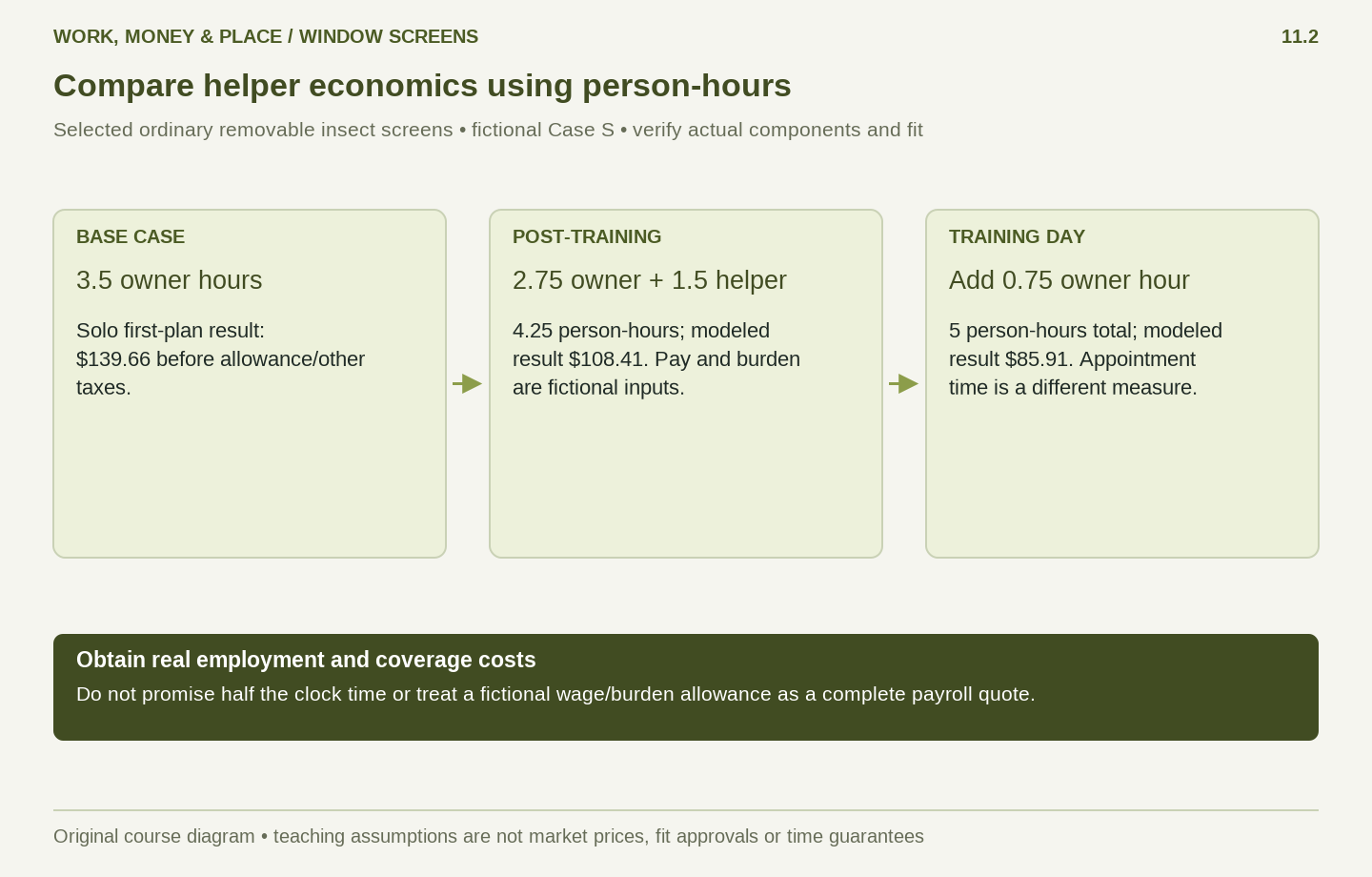
The solo Case S first plan uses 3.5 full-cycle owner hours. In a separate post-training helper trial on that same first-visit scope, assume the owner uses 2.75 hours and the helper uses 1.5 hours. The combined labor is 4.25 person-hours, not 2.75 and not half the original 3.5. Those hours can overlap in different ways and include work outside the visible appointment. The scenario does not supply enough information to promise a halved onsite clock or another full job on the same day.
Training changes the comparison again. Assume an additional 0.75 owner hour on the first training day. The owner then uses 3.5 hours and the helper 1.5, totaling 5 person-hours. Record this separately from the post-training scenario rather than hiding the training effort inside a future efficiency claim. A real record should identify what was taught, what was checked and whether the helper demonstrated the supported method. Faster output without acceptable identification and final fit is not an improvement in the service being sold.
Add the whole cost of the specific arrangement
For this teaching comparison only, the helper rate is a hypothetical $25 per hour. At 1.5 hours that is $37.50. Add an illustrative $11.25 employer-cost allowance and $5 of extra operating costs, producing $53.75 of incremental modeled cost. None of those amounts is a verified wage recommendation, local legal minimum or complete payroll, insurance and benefit quotation. Obtain the applicable actual costs and obligations before using a real hiring decision.
Federal tax classification depends on the actual working relationship, and state workers’ compensation and labor rules require their own assessment. Calling someone a contractor, paying an invoice or seeing a business number does not settle those tests. Consider payroll administration, coverage, applicable taxes, supervision, transport, protective controls and tool capacity as relevant to the real role. Do not use an unpaid or misclassified trial to make the spreadsheet look favorable. A low hourly headline can hide costs that are larger than the assumed owner-time saving.
Calculate the comparison on a matching basis
The accepted solo first-job management result is $139.66 before the separate planning allowance and other applicable business taxes. Reducing owner time by 0.75 hour at the chosen $30 value saves $22.50. The helper arrangement adds $53.75, so the post-training scenario is $139.66 + $22.50 − $53.75 = $108.41 on the same before-allowance basis. Keeping the customer price unchanged does not turn a labor-saving story into a higher result; the extra cost exceeds the modeled owner saving.
On the training day, the additional 0.75 owner hour costs another $22.50 in management value, giving $85.91 before allowance and other business taxes. Preserve the unchanged accepted price, original material/fuel assumptions and separate scenarios. Do not mix these figures into the base Case S result or the alternative actual-first error path. If you propose a new customer price, calculate it explicitly and test whether the revised offer is appropriate. A spreadsheet comparison is not customer authorization to raise an already accepted charge.
Choose help for a supported operational reason
The lower modeled result does not prove that help can never make sense. A particular arrangement may relieve a real physical or scheduling constraint, support quality or make an appropriate larger job possible. Those benefits need evidence and a complete comparison. Do not count an extra theoretical visit as earned revenue before the freed time, compatible stock, travel and customer demand support it. Set a bounded trial with the actual role, competence checks, paid/covered arrangement, capacity measure and quality review defined beforehand.
After the trial, record each person’s actual time, full incremental cash and management costs, defects, rework and the ability to maintain identification and trial-fit standards. Compare with the same scope performed solo where evidence exists. Keep a decision to continue, modify or stop the arrangement with a reason. The goal is not to have employees as a symbol of success; it is to match people, tools, commitments and demand while retaining a service you can inspect and a business result you can explain.
Put it into practice
Your assignment
Evaluate the approved hypothetical helper trial.
Inputs
- Same first-visit scope and price; solo result $139.66.
- Post-training: owner 2.75 h, helper 1.5 h at hypothetical $25, burden allowance $11.25, extra costs $5.
- Training day adds 0.75 owner hour at chosen $30 value.
Your deliverable
S22 side-by-side management comparison and S03 capacity note.
Saved only in this browser when storage is available. Export this page separately and use fictional identifiers in practice.
Show the worked answer
- Post-training person-hours = 4.25; training-day person-hours = 5. No half-clock claim follows.
- Owner saving $22.50; incremental modeled helper cost $53.75; result $108.41. Training owner effort lowers it to $85.91.
- Keep all comparisons before allowance/other business taxes and outside base Case S. Obtain real classification, payroll and coverage costs before an actual trial.
Show the self-check criteria
- Scope, price and result basis match.
- Hypothetical pay/burden are not marketed as verified employment costs.
- Coordination, training and quality remain part of the decision.